Ch.21 - Nuclear Chemistry
Brown - Chemistry: The Central Science 14th Edition
Brown14th EditionChemistry: The Central ScienceISBN: 9780134414232Non è quello che usi tu?Cambia libro di testo
Capitolo 21, Problema 50a

The atomic masses of nitrogen-14, titanium-48, and xenon-129 are 13.999234 amu, 47.935878 amu, and 128.904779 amu, respectively. For each isotope, calculate (a) the nuclear mass.

Guida verificata passo dopo passo
1
1. The nuclear mass of an isotope is the mass of the protons and neutrons in the nucleus. The atomic mass unit (amu) is defined such that the mass of a carbon-12 atom is exactly 12 amu. This means that 1 amu is approximately equal to the mass of a proton or a neutron.
2. To calculate the nuclear mass of an isotope, you need to know the number of protons and neutrons in the nucleus. The atomic number of an element gives the number of protons, and the mass number (the number in the isotope's name) gives the total number of protons and neutrons. Subtract the atomic number from the mass number to find the number of neutrons.
3. For nitrogen-14, the atomic number of nitrogen is 7, so there are 7 protons and 7 neutrons. Multiply the number of protons and neutrons by 1 amu to get the nuclear mass.
4. Repeat this process for titanium-48 and xenon-129. The atomic number of titanium is 22, so there are 22 protons and 26 neutrons. The atomic number of xenon is 54, so there are 54 protons and 75 neutrons.
5. Remember that these calculations will give you an approximate nuclear mass. The actual nuclear mass may be slightly different due to the binding energy of the nucleus, which is not accounted for in this calculation.

Risposta video verificata per un problema simile:

Questa soluzione video è stata consigliata dai nostri tutor come utile per risolvere questo problema.
Durata del video:
4m

Concetti chiave

Ecco i concetti essenziali che devi comprendere per rispondere correttamente alla domanda.

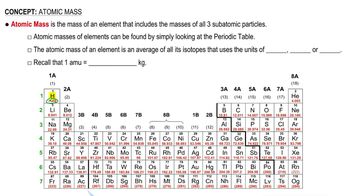
Atomic Mass Unit (amu)

The atomic mass unit (amu) is a standard unit of mass used to express atomic and molecular weights. It is defined as one twelfth of the mass of a carbon-12 atom, which is approximately 1.66 x 10^-27 kg. This unit allows chemists to compare the mass of different atoms and molecules on a relative scale, making it easier to understand their properties and behaviors in chemical reactions.
Video consigliato:

Nuclear Mass

Nuclear mass refers to the mass of an atomic nucleus, which is primarily determined by the number of protons and neutrons it contains. This mass is slightly less than the sum of the individual masses of the nucleons due to the binding energy that holds them together, as described by Einstein's equation E=mc². To calculate the nuclear mass, one must account for this mass defect, which is the difference between the total mass of the separate nucleons and the actual mass of the nucleus.
Video consigliato:
Percorso guidato
02:06
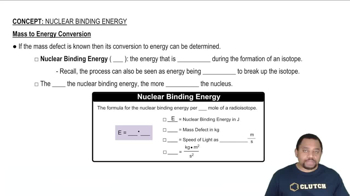
Nuclear Binding Energy

Isotopes

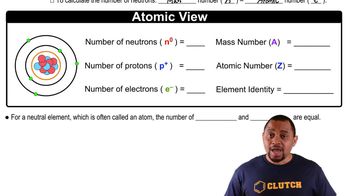
Isotopes are variants of a particular chemical element that have the same number of protons but different numbers of neutrons, resulting in different atomic masses. For example, nitrogen-14 has 7 protons and 7 neutrons, while nitrogen-15 has 7 protons and 8 neutrons. Understanding isotopes is crucial for calculations involving nuclear mass, as each isotope's unique neutron count affects its overall mass and stability.
Video consigliato: