Ch.24 - The Chemistry of Life: Organic and Biological Chemistry
Brown - Chemistry: The Central Science 14th Edition
Brown14th EditionChemistry: The Central ScienceISBN: 9780134414232Non è quello che usi tu?Cambia libro di testo
Capitolo 24, Problema 57a2

(a) Draw Lewis structures for chloromethane 1CH3Cl2, chloroethene 1C2H3Cl2, and chloroethyne 1C2HCl2. Draw Lewis structures for chloroethene 1C2H3Cl2.

Guida verificata passo dopo passo
1
Identify the total number of valence electrons for each molecule. For chloromethane (CH3Cl), carbon has 4 valence electrons, each hydrogen has 1, and chlorine has 7. For chloroethene (C2H3Cl), each carbon has 4 valence electrons, each hydrogen has 1, and chlorine has 7. For chloroethyne (C2HCl), each carbon has 4 valence electrons, hydrogen has 1, and chlorine has 7.
Arrange the atoms in each molecule. In chloromethane, carbon is the central atom with three hydrogens and one chlorine attached. In chloroethene, the two carbons are double bonded, with two hydrogens on one carbon and one hydrogen and one chlorine on the other. In chloroethyne, the two carbons are triple bonded, with one hydrogen on one carbon and one chlorine on the other.
Distribute the remaining electrons to satisfy the octet rule (or duet rule for hydrogen). Each hydrogen should have 2 electrons, and each other atom should aim for 8 electrons around it.
Check the formal charges to ensure the most stable structure. The sum of the formal charges in the molecule should equal the overall charge of the molecule (which is neutral in these cases).
Draw the Lewis structures based on the above steps, using lines for bonds and dots for lone pairs. Ensure that each bond and lone pair is placed correctly according to the electron distribution and formal charge calculations.

Risposta video verificata per un problema simile:

Questa soluzione video è stata consigliata dai nostri tutor come utile per risolvere questo problema.
Durata del video:
1m

Concetti chiave

Ecco i concetti essenziali che devi comprendere per rispondere correttamente alla domanda.

Lewis Structures

Lewis structures are diagrams that represent the bonding between atoms in a molecule and the lone pairs of electrons that may exist. They use dots to represent valence electrons and lines to indicate bonds between atoms. Understanding how to draw Lewis structures is essential for visualizing molecular geometry and predicting the reactivity of compounds.
Video consigliato:
Percorso guidato
04:28
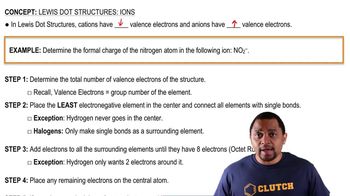
Lewis Dot Structures: Ions

Valence Electrons

Valence electrons are the outermost electrons of an atom and are crucial in determining how atoms bond with each other. The number of valence electrons influences the molecule's structure and stability. In drawing Lewis structures, it is important to account for the total number of valence electrons contributed by all atoms involved to ensure accurate representation.
Video consigliato:
Percorso guidato
02:12
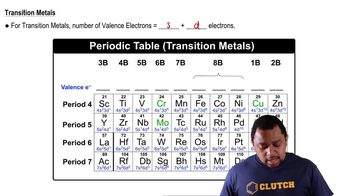
Transition Metals Valence Electrons

Molecular Geometry

Molecular geometry refers to the three-dimensional arrangement of atoms within a molecule. It is influenced by the number of bonds and lone pairs around the central atom, which can affect the molecule's physical and chemical properties. Understanding molecular geometry is important for predicting the behavior of molecules in reactions and their interactions with other substances.
Video consigliato:
Percorso guidato
01:33
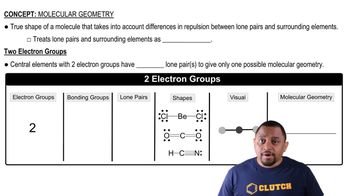
Molecular Geometry with Two Electron Groups