Ch.3 - Chemical Reactions and Reaction Stoichiometry
Brown - Chemistry: The Central Science 14th Edition
Brown14th EditionChemistry: The Central ScienceISBN: 9780134414232Non è quello che usi tu?Cambia libro di testo
Capitolo 3, Problema 24

Determine the formula weights of each of the following compounds: (a) Butyric acid, CH3CH2CH2COOH, which is responsible for the rotten smell of spoiled food (b) sodium perborate, NaBO3, a substance used as bleach (c) CF2Cl2, a refrigerant known as Freon (d) NaHCO3, known as baking soda and used in bread and pastry baking (e) isopentyl acetate, CH3CO2C5H11, responsible for the odor of bananas.

Guida verificata passo dopo passo
1
Identify the elements and their respective counts in the molecular formula of isopentyl acetate, CH3CO2C5H11. The formula can be broken down as: 2 Carbon atoms from the acetyl group (CH3CO), 5 Carbon atoms and 11 Hydrogen atoms from the pentyl group (C5H11), and 2 Oxygen atoms from the acetate group (CO2).
Calculate the total number of each type of atom in the compound: Carbon atoms = 2 (from acetyl) + 5 (from pentyl) = 7, Hydrogen atoms = 3 (from acetyl) + 11 (from pentyl) = 14, Oxygen atoms = 2 (from acetate).
Look up the atomic weights for each element from the periodic table: Carbon (C) approximately 12.01 amu, Hydrogen (H) approximately 1.008 amu, and Oxygen (O) approximately 16.00 amu.
Multiply the atomic weight of each element by the number of atoms of that element in the compound: Carbon contribution = 7 atoms × 12.01 amu, Hydrogen contribution = 14 atoms × 1.008 amu, Oxygen contribution = 2 atoms × 16.00 amu.
Add up all the contributions to get the total formula weight of isopentyl acetate: Total formula weight = Carbon contribution + Hydrogen contribution + Oxygen contribution.

Risposta video verificata per un problema simile:

Questa soluzione video è stata consigliata dai nostri tutor come utile per risolvere questo problema.
Durata del video:
1m

Concetti chiave

Ecco i concetti essenziali che devi comprendere per rispondere correttamente alla domanda.

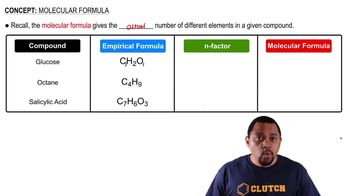
Molecular Formula

The molecular formula of a compound indicates the number and types of atoms present in a molecule. For isopentyl acetate, the formula is CH3CO2C5H11, which shows it contains carbon (C), hydrogen (H), and oxygen (O) atoms. Understanding how to interpret molecular formulas is essential for calculating formula weights.
Video consigliato:
Percorso guidato
02:08
Determining Molecular Formulas

Molar Mass Calculation

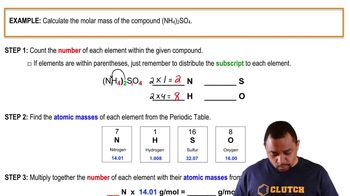
Molar mass is the mass of one mole of a substance, calculated by summing the atomic masses of all atoms in the molecular formula. Each element's atomic mass can be found on the periodic table. For isopentyl acetate, you would multiply the number of each type of atom by its atomic mass and then sum these values to find the total formula weight.
Video consigliato:
Percorso guidato
03:12
Molar Mass Calculation Example

Empirical vs. Molecular Formula

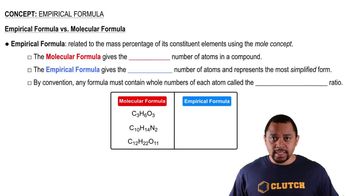
The empirical formula represents the simplest whole-number ratio of atoms in a compound, while the molecular formula shows the actual number of atoms. In the case of isopentyl acetate, understanding the difference helps in recognizing that the molecular formula provides more detailed information about the compound's structure and composition, which is crucial for accurate weight calculations.
Video consigliato:
Percorso guidato
02:26
Empirical vs Molecular Formula