Ch.4 - Reactions in Aqueous Solution
Brown - Chemistry: The Central Science 14th Edition
Brown14th EditionChemistry: The Central ScienceISBN: 9780134414232Non è quello che usi tu?Cambia libro di testo
Capitolo 4, Problema 105d

Suppose you have 3.00 g of powdered zinc metal, 3.00g of powdered silver metal and 500.0 mL of a 0.2 M copper(II) nitrate solution. (d) What is the molarity of Cu2+ ions in the resulting solution?

Guida verificata passo dopo passo
1
insert step 1> Calculate the moles of copper(II) nitrate in the solution using the formula: moles = molarity \(\times\) volume. Remember to convert the volume from mL to L.
insert step 2> Write the balanced chemical equations for the reactions of zinc and silver with copper(II) nitrate.
insert step 3> Determine the limiting reactant by calculating the moles of zinc and silver and comparing them to the stoichiometry of the reactions.
insert step 4> Calculate the moles of Cu^{2+} ions that react based on the limiting reactant and the stoichiometry of the reaction.
insert step 5> Subtract the moles of Cu^{2+} ions that reacted from the initial moles of Cu^{2+} ions to find the moles of Cu^{2+} ions remaining. Then, calculate the molarity of Cu^{2+} ions in the resulting solution by dividing the remaining moles by the total volume of the solution in liters.

Risposta video verificata per un problema simile:

Questa soluzione video è stata consigliata dai nostri tutor come utile per risolvere questo problema.
Durata del video:
12m

Concetti chiave

Ecco i concetti essenziali che devi comprendere per rispondere correttamente alla domanda.

Molarity

Molarity is a measure of concentration defined as the number of moles of solute per liter of solution. It is expressed in moles per liter (M). To calculate molarity, one must know the amount of solute in grams, convert it to moles using the molar mass, and then divide by the volume of the solution in liters.
Video consigliato:

Stoichiometry

Stoichiometry involves the calculation of reactants and products in chemical reactions. It is based on the balanced chemical equation, which shows the ratio of moles of each substance involved. Understanding stoichiometry is essential for determining how much of each reactant is consumed and how much product is formed, which is crucial for calculating concentrations after a reaction.
Video consigliato:
Percorso guidato
01:16
Stoichiometry Concept

Copper(II) Nitrate Dissociation

Copper(II) nitrate (Cu(NO3)2) dissociates in solution to release Cu2+ ions and nitrate ions (NO3-). The dissociation is complete in a strong electrolyte like copper(II) nitrate, meaning that the concentration of Cu2+ ions in the solution will be equal to the initial molarity of the copper(II) nitrate solution, assuming no other reactions consume the Cu2+ ions.
Video consigliato:
Percorso guidato
04:52
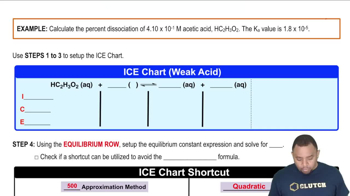
Percent Dissociation Example
Pratica correlata
Domanda del libro di testo

(a) By titration, 15.0 mL of 0.1008 M sodium hydroxide is needed to neutralize a 0.2053-g sample of a weak acid. What is the molar mass of the acid if it is monoprotic?

1329
views

Domanda del libro di testo
The discovery of hafnium, element number 72, provided a controversial episode in chemistry. G. Urbain, a French chemist, claimed in 1911 to have isolated an element number 72 from a sample of rare earth (elements 58–71) compounds. However, Niels Bohr believed that hafnium was more likely to be found along with zirconium than with the rare earths. D. Coster and G. von Hevesy, working in Bohr's laboratory in Copenhagen, showed in 1922 that element 72 was present in a sample of Norwegian zircon, an ore of zirconium. (The name hafnium comes from the Latin name for Copenhagen, Hafnia). (c) Solid zirconium dioxide, ZrO2, reacts with chlorine gas in the presence of carbon. The products of the reaction are ZrCl4 and two gases, CO2 and CO in the ratio 1:2. Write a balanced chemical equation for the reaction.
655
views
Domanda del libro di testo

Suppose you have 3.00 g of powdered zinc metal, 3.00g of powdered silver metal and 500.0 mL of a 0.2 M copper(II) nitrate solution. (b) What is the net ionic equation that describes this reaction?

1
views
Domanda del libro di testo

(b) An elemental analysis of the acid indicates that it is composed of 5.89% H, 70.6% C, and 23.5% O by mass. What is its molecular formula?

1437
views
Domanda del libro di testo

Suppose you have 3.00 g of powdered zinc metal, 3.00g of powdered silver metal and 500.0 mL of a 0.2 M copper(II) nitrate solution. (a) Which metal will react with the copper(II) nitrate solution?

330
views
Domanda del libro di testo
(c) If 18.65 mL of the caesium hydroxide solution was needed to neutralize a 42.3 mL aliquot of the hydroiodic acid solution, what is the concentration (molarity) of the acid?
492
views