
The specific heat of octane, C8H18(l), is 2.22 J•g/K. (b) Which will require more heat, increasing the temperature of 1 mol of C8H18(l), by a certain amount or increasing the temperature of 1 mol of H2O(l) by the same amount?
Ch.5 - Thermochemistry
Brown14th EditionChemistry: The Central ScienceISBN: 9780134414232Non è quello che usi tu?Cambia libro di testo
Capitolo 5, Problema 53a
The specific heat of octane, C8H18(l), is 2.22 J•g/K. (a) How many J of heat are needed to raise the temperature of 80.0 g of octane from 10.0 to 25.0 °C?
Guida verificata passo dopo passo1
Identify the given values: specific heat (c) = 2.22 J/g/K, mass (m) = 80.0 g, initial temperature (T1) = 10.0 °C, and final temperature (T2) = 25.0 °C.
Calculate the change in temperature (ΔT) by subtracting the initial temperature from the final temperature: ΔT = T2 - T1.
Use the formula for heat transfer, Q = mcΔT, where Q is the heat energy transferred, m is the mass, c is the specific heat, and ΔT is the change in temperature.
Substitute the values into the formula: Q = (80.0 g) * (2.22 J/g/K) * (ΔT from step 2).
Calculate the product to find the total heat energy (Q) required in joules.

Risposta video verificata per un problema simile:
Questa soluzione video è stata consigliata dai nostri tutor come utile per risolvere questo problema.
Durata del video:
1mConcetti chiave
Ecco i concetti essenziali che devi comprendere per rispondere correttamente alla domanda.
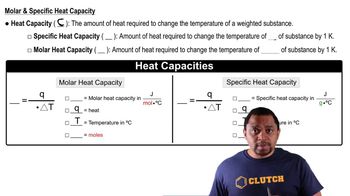
Specific Heat Capacity
Specific heat capacity is the amount of heat required to raise the temperature of one gram of a substance by one degree Celsius (or Kelvin). It is a material-specific property that indicates how much energy is needed to change the temperature of a given mass of the substance. In this case, octane has a specific heat of 2.22 J/g·K, meaning it requires 2.22 joules of energy to increase the temperature of one gram of octane by one degree.
Video consigliato:
Percorso guidato
Heat Capacity
Heat Transfer Calculation
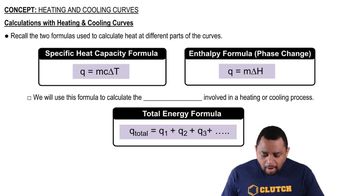
The heat transfer (q) required to change the temperature of a substance can be calculated using the formula q = m × c × ΔT, where m is the mass of the substance, c is the specific heat capacity, and ΔT is the change in temperature. This formula allows us to quantify the energy needed for temperature changes in various materials, making it essential for solving problems related to thermal energy.
Video consigliato:
Percorso guidato
Calculations with Heating and Cooling Curves
Temperature Change
Temperature change (ΔT) is the difference between the final and initial temperatures of a substance. It is calculated as ΔT = T_final - T_initial. In the context of the question, the temperature change for octane is from 10.0 °C to 25.0 °C, which is a critical component in determining the total heat required for the temperature increase, as it directly influences the amount of energy needed.
Video consigliato:
Percorso guidato
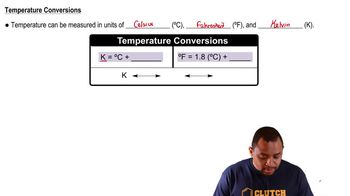
Temperature Conversion Formulas
Pratica correlata
Domanda del libro di testo
2232
views
Domanda del libro di testo
Consider the data about gold metal in Exercise 5.26(b). (a) Based on the data, calculate the specific heat of Au(s).
Domanda del libro di testo
Consider the data about gold metal in Exercise 5.26(b). (b) Suppose that the same amount of heat is added to two 10.0-g blocks of metal, both initially at the same temperature. One block is gold metal, and one is iron metal. Which block will have the greater rise in temperature after the addition of the heat?
667
views
Domanda del libro di testo
(d) How many kJ of heat are needed to raise the temperature of 5.00 kg of liquid water from 24.6 to 46.2 °C?
1534
views
1
rank
Domanda del libro di testo
(b) Calculate the energy needed for this temperature change.
1316
views
Domanda del libro di testo
(c) What is the heat capacity of 185 g of liquid water?
676
views
