Ch.6 - Electronic Structure of Atoms
Brown - Chemistry: The Central Science 14th Edition
Brown14th EditionChemistry: The Central ScienceISBN: 9780134414232Non è quello che usi tu?Cambia libro di testo
Capitolo 6, Problema 25c

(c) What wavelength of radiation has photons of energy 6.06 × 10⁻¹⁹ J?

Guida verificata passo dopo passo
1
Start by recalling the relationship between the energy of a photon and its wavelength, which is given by the equation: \( E = \frac{hc}{\lambda} \), where \( E \) is the energy of the photon, \( h \) is Planck's constant (\( 6.626 \times 10^{-34} \) J·s), \( c \) is the speed of light (\( 3.00 \times 10^8 \) m/s), and \( \lambda \) is the wavelength.
Rearrange the equation to solve for wavelength \( \lambda \): \( \lambda = \frac{hc}{E} \).
Substitute the known values into the equation: \( h = 6.626 \times 10^{-34} \) J·s, \( c = 3.00 \times 10^8 \) m/s, and \( E = 6.06 \times 10^{-19} \) J.
Calculate the numerator \( hc \) by multiplying Planck's constant \( h \) by the speed of light \( c \).
Divide the result from the previous step by the energy \( E \) to find the wavelength \( \lambda \).

Risposta video verificata per un problema simile:

Questa soluzione video è stata consigliata dai nostri tutor come utile per risolvere questo problema.

Concetti chiave

Ecco i concetti essenziali che devi comprendere per rispondere correttamente alla domanda.

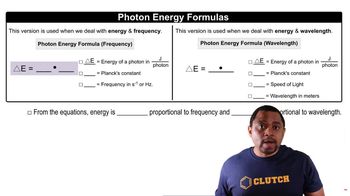
Photon Energy

Photon energy is the energy carried by a single photon, which is a particle of light. It is directly proportional to the frequency of the radiation and inversely proportional to its wavelength. The energy of a photon can be calculated using the equation E = hν, where E is energy, h is Planck's constant (6.626 × 10^-34 J·s), and ν is the frequency of the radiation.
Video consigliato:
Percorso guidato
01:40
Photon Energy Formulas

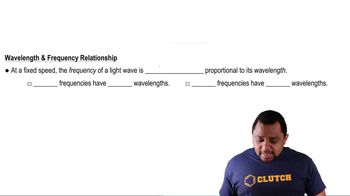
Wavelength and Frequency Relationship

The relationship between wavelength and frequency is described by the equation c = λν, where c is the speed of light (approximately 3.00 × 10^8 m/s), λ is the wavelength, and ν is the frequency. This equation shows that as the wavelength increases, the frequency decreases, and vice versa. Understanding this relationship is crucial for converting between energy, wavelength, and frequency.
Video consigliato:
Percorso guidato
00:31
Frequency-Wavelength Relationship

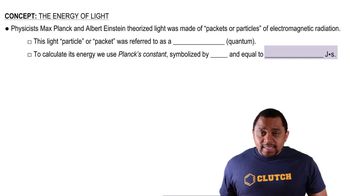
Planck's Constant

Planck's constant is a fundamental constant in quantum mechanics, denoted as h, with a value of approximately 6.626 × 10^-34 J·s. It relates the energy of a photon to its frequency, serving as a bridge between the macroscopic and quantum worlds. This constant is essential for calculations involving photon energy and is a key component in the equations used to solve problems related to electromagnetic radiation.
Video consigliato:
Percorso guidato
00:50
Photons and Planck's Constant