Ch.6 - Electronic Structure of Atoms
Brown - Chemistry: The Central Science 14th Edition
Brown14th EditionChemistry: The Central ScienceISBN: 9780134414232Non è quello che usi tu?Cambia libro di testo
Capitolo 6, Problema 44a

The hydrogen atom can absorb light of wavelength 1094 nm. (a) In what region of the electromagnetic spectrum is this absorption found?

Guida verificata passo dopo passo
1
Identify the given wavelength of light absorbed by the hydrogen atom, which is 1094 nm.
Convert the wavelength from nanometers to meters for standard unit consistency. Use the conversion factor: 1 nm = 1 x 10⁻⁹ m.
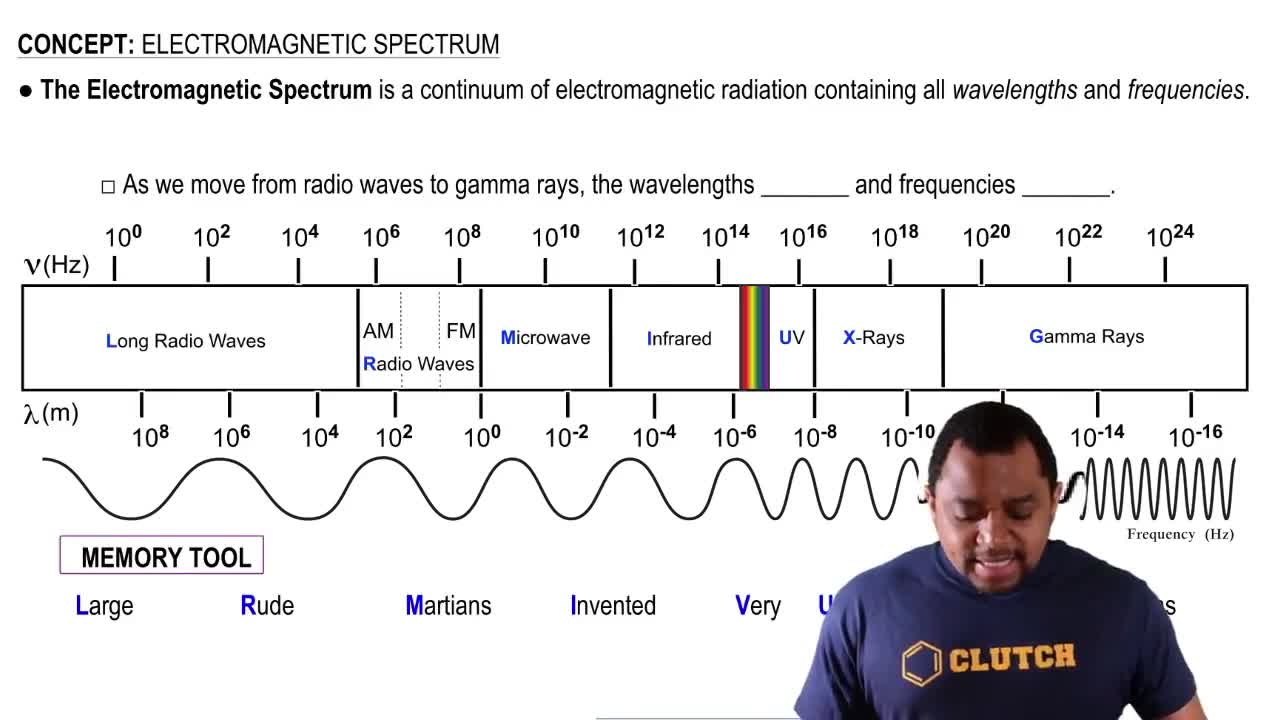
Recall the regions of the electromagnetic spectrum and their corresponding wavelength ranges. The main regions include radio, microwave, infrared, visible, ultraviolet, X-rays, and gamma rays.
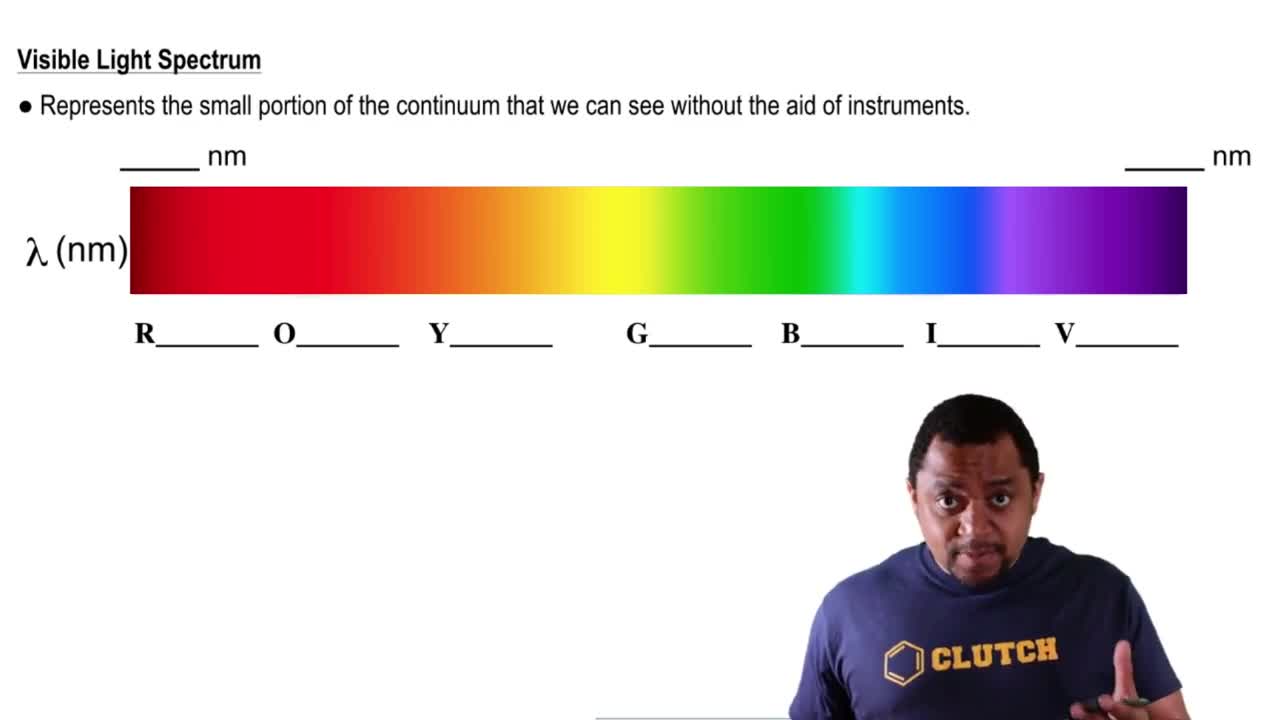
Determine which region the wavelength of 1094 nm falls into by comparing it to the known wavelength ranges of the electromagnetic spectrum. For example, the infrared region typically ranges from about 700 nm to 1 mm.
Conclude that the absorption of light by the hydrogen atom at 1094 nm falls within the infrared region of the electromagnetic spectrum.

Risposta video verificata per un problema simile:

Questa soluzione video è stata consigliata dai nostri tutor come utile per risolvere questo problema.
Durata del video:
1m

Concetti chiave

Ecco i concetti essenziali che devi comprendere per rispondere correttamente alla domanda.

Electromagnetic Spectrum

The electromagnetic spectrum encompasses all types of electromagnetic radiation, arranged by wavelength or frequency. It includes various regions such as radio waves, microwaves, infrared, visible light, ultraviolet, X-rays, and gamma rays. Understanding where a specific wavelength falls within this spectrum is crucial for identifying its properties and interactions with matter.
Video consigliato:
Percorso guidato
02:53
Electromagnetic Spectrum

Wavelength and Energy Relationship

The energy of electromagnetic radiation is inversely related to its wavelength, described by the equation E = hc/λ, where E is energy, h is Planck's constant, c is the speed of light, and λ is the wavelength. Shorter wavelengths correspond to higher energy photons, while longer wavelengths correspond to lower energy. This relationship is essential for determining the energy associated with the absorption of light by atoms.
Video consigliato:
Percorso guidato
00:31
Frequency-Wavelength Relationship

Infrared Region

The infrared region of the electromagnetic spectrum typically ranges from about 700 nm to 1 mm in wavelength. The absorption of light at 1094 nm indicates that this wavelength falls within the infrared range. This region is significant in various applications, including thermal imaging and spectroscopy, as it relates to molecular vibrations and transitions.
Video consigliato:
Percorso guidato
01:24
Visible Light Spectrum