Ch.1 - Introduction: Matter, Energy, and Measurement
Brown - Chemistry: The Central Science 15th Edition
Brown15th EditionChemistry: The Central ScienceISBN: 9780137542970Non è quello che usi tu?Cambia libro di testo
Capitolo 1, Problema 35e

Make the following conversions: e. 2500 °F to K

Guida verificata passo dopo passo
1
Start by converting the temperature from Fahrenheit (°F) to Celsius (°C) using the formula: \( °C = \frac{5}{9} (°F - 32) \).
Substitute 2500 °F into the formula: \( °C = \frac{5}{9} (2500 - 32) \).
Calculate the value inside the parentheses: \( 2500 - 32 \).
Multiply the result by \( \frac{5}{9} \) to find the temperature in Celsius.
Convert the temperature from Celsius to Kelvin (K) using the formula: \( K = °C + 273.15 \).

Risposta video verificata per un problema simile:

Questa soluzione video è stata consigliata dai nostri tutor come utile per risolvere questo problema.
Durata del video:
1m

Concetti chiave

Ecco i concetti essenziali che devi comprendere per rispondere correttamente alla domanda.

Temperature Scales

Temperature can be measured in different scales, primarily Fahrenheit (°F), Celsius (°C), and Kelvin (K). Each scale has its own zero point and degree increments. Understanding how these scales relate to one another is crucial for converting temperatures accurately.
Video consigliato:
02:33
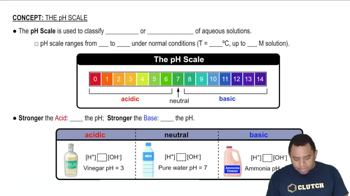
The pH Scale

Conversion Formulas

To convert temperatures between different scales, specific formulas are used. For example, to convert Fahrenheit to Kelvin, one must first convert Fahrenheit to Celsius using the formula °C = (°F - 32) × 5/9, and then convert Celsius to Kelvin using K = °C + 273.15. Mastery of these formulas is essential for accurate conversions.
Video consigliato:
01:56
Conversion Factors

Absolute Zero

Kelvin is an absolute temperature scale where 0 K represents absolute zero, the theoretical point where all molecular motion ceases. This concept is important because it provides a baseline for temperature measurements, and understanding it helps in grasping the significance of temperature in scientific contexts.
Video consigliato:
02:44
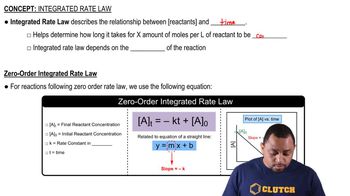
Zero-Order Reactions