
Ch.10 - Gases
Brown - Chemistry: The Central Science 15th Edition
Brown15th EditionChemistry: The Central ScienceISBN: 9780137542970Non è quello che usi tu?Cambia libro di testo
Capitolo 10, Problema 43b

Chlorine is widely used to purify municipal water supplies and to treat swimming pool waters. Suppose that the volume of a particular sample of Cl2 gas is 8.70 L at 895 torr and 24°C. b. What volume will the Cl2 occupy at STP?

Guida verificata passo dopo passo
1
Step 1: Identify the given values and what you need to find. In this case, the initial volume (V1) is 8.70 L, the initial pressure (P1) is 895 torr, and the initial temperature (T1) is 24°C. You need to find the final volume (V2) at standard temperature and pressure (STP), which is 0°C and 1 atm (or 760 torr).
Step 2: Convert all the given values to the appropriate units. The temperature should be in Kelvin (K), so convert 24°C to Kelvin by adding 273.15. The pressure should be in the same units, so keep it in torr.
Step 3: Use the combined gas law, which is (P1*V1)/T1 = (P2*V2)/T2. Since we are looking for V2, we can rearrange the equation to V2 = (P1*V1*T2) / (P2*T1).
Step 4: Substitute the given values into the equation. P1 is 895 torr, V1 is 8.70 L, T1 is the temperature in Kelvin from step 2, P2 is 760 torr (the standard pressure), and T2 is 273.15 K (the standard temperature).
Step 5: Solve the equation to find V2. This will give you the volume of the Cl2 gas at STP.

Risposta video verificata per un problema simile:

Questa soluzione video è stata consigliata dai nostri tutor come utile per risolvere questo problema.
Durata del video:
2m

Concetti chiave

Ecco i concetti essenziali che devi comprendere per rispondere correttamente alla domanda.

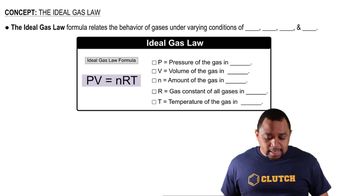
Ideal Gas Law

The Ideal Gas Law relates the pressure, volume, temperature, and number of moles of a gas through the equation PV = nRT. This law is essential for understanding how gases behave under different conditions and allows for the calculation of one variable when the others are known.
Video consigliato:
Percorso guidato
01:15
Ideal Gas Law Formula

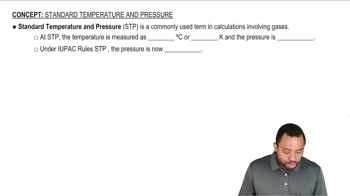
Standard Temperature and Pressure (STP)

Standard Temperature and Pressure (STP) is defined as a temperature of 0°C (273.15 K) and a pressure of 1 atm (760 torr). At STP, one mole of an ideal gas occupies 22.4 L, which is a critical reference point for gas calculations and conversions.
Video consigliato:
Percorso guidato
01:08
Standard Temperature and Pressure

Gas Volume Conversion

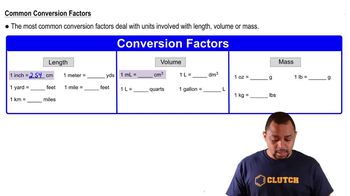
Gas volume conversion involves adjusting the volume of a gas from one set of conditions (like temperature and pressure) to another. This is often done using the combined gas law, which allows for the calculation of the new volume when transitioning from non-STP conditions to STP.
Video consigliato:
Percorso guidato
02:38
Common Conversion Factors
Pratica correlata
Domanda del libro di testo

Many gases are shipped in high-pressure containers. Consider a steel tank whose volume is 55.0 gallons that contains O2 gas at a pressure of 16,500 kPa at 23°C. c. At what temperature would the pressure in the tank equal 150.0 atm?

Domanda del libro di testo

Chlorine is widely used to purify municipal water supplies and to treat swimming pool waters. Suppose that the volume of a particular sample of Cl2 gas is 8.70 L at 895 torr and 24°C. c. At what temperature will the volume be 15.00 L if the pressure is 8.76×10² torr?

Domanda del libro di testo

Many gases are shipped in high-pressure containers. Consider a steel tank whose volume is 55.0 gallons that contains O2 gas at a pressure of 16,500 kPa at 23°C. b. What volume would the gas occupy at STP?

Domanda del libro di testo

A 35.1 g sample of solid CO2 (dry ice) is added to a container at a temperature of 100 K with a volume of 4.0 L. If the container is evacuated (all of the gas is removed), sealed, and then allowed to warm to room temperature (𝑇=298 K) so that all of the solid CO2 is converted to a gas, what is the pressure inside the container?

Domanda del libro di testo

An aerosol spray can with a volume of 250 mL contains 2.30 g of propane gas (C3H8) as a propellant. c. The can’s label says that exposure to temperatures above 130°F may cause the can to burst. What is the pressure in the can at this temperature?

Domanda del libro di testo

A 334-mL cylinder for use in chemistry lectures contains 5.225 g of helium at 23°C. How many grams of helium must be released to reduce the pressure to 75 atm assuming ideal-gas behavior?