Ch.10 - Gases
Brown - Chemistry: The Central Science 15th Edition
Brown15th EditionChemistry: The Central ScienceISBN: 9780137542970Non è quello che usi tu?Cambia libro di testo
Capitolo 10, Problema 103a

Assume that an exhaled breath of air consists of 74.8% N2, 15.3% O2, 3.7% CO2, and 6.2% water vapor. a. If the total pressure of the gases is 0.985 atm, calculate the partial pressure of each component of the mixture.

Guida verificata passo dopo passo
1
Identify the given percentages of each gas in the mixture: 74.8% N_2, 15.3% O_2, 3.7% CO_2, and 6.2% H_2O.
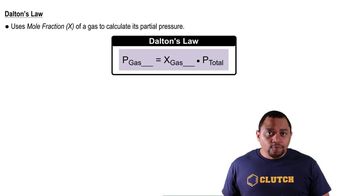
Understand that the partial pressure of a gas in a mixture is given by Dalton's Law of Partial Pressures, which states that the partial pressure of a gas is equal to the mole fraction of the gas multiplied by the total pressure.
Convert the percentages to mole fractions by dividing each percentage by 100. For example, the mole fraction of N_2 is 0.748.
Calculate the partial pressure of each gas by multiplying its mole fraction by the total pressure (0.985 atm). For example, the partial pressure of N_2 is 0.748 * 0.985 atm.
Repeat the calculation for each gas: O_2, CO_2, and H_2O, using their respective mole fractions and the total pressure.

Risposta video verificata per un problema simile:

Questa soluzione video è stata consigliata dai nostri tutor come utile per risolvere questo problema.
Durata del video:
1m

Concetti chiave

Ecco i concetti essenziali che devi comprendere per rispondere correttamente alla domanda.

Dalton's Law of Partial Pressures

Dalton's Law states that in a mixture of non-reacting gases, the total pressure exerted is equal to the sum of the partial pressures of each individual gas. Each gas in the mixture contributes to the total pressure in proportion to its mole fraction. This principle is essential for calculating the partial pressures of gases in a mixture, as it allows us to determine how much each gas contributes to the overall pressure.
Video consigliato:
Percorso guidato
00:27
Dalton's Law and Partial Pressure

Mole Fraction

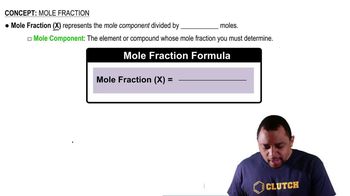
The mole fraction is a way of expressing the concentration of a component in a mixture. It is defined as the ratio of the number of moles of a specific component to the total number of moles of all components in the mixture. In the context of gas mixtures, the mole fraction can be used to calculate the partial pressure of each gas by multiplying the mole fraction by the total pressure.
Video consigliato:
Percorso guidato
00:36
Mole Fraction Formula

Gas Laws

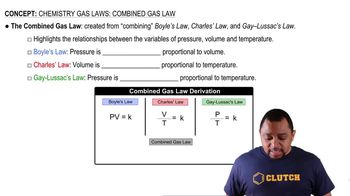
Gas laws describe the behavior of gases under various conditions of temperature, pressure, and volume. The ideal gas law, PV=nRT, relates pressure (P), volume (V), temperature (T), and the number of moles (n) of a gas. Understanding these laws is crucial for solving problems involving gas mixtures, as they provide the foundational relationships needed to manipulate and calculate the properties of gases.
Video consigliato:
Percorso guidato
01:43
Combined Gas Law
Pratica correlata
Domanda del libro di testo

Assume that a single cylinder of an automobile engine has a volume of 524 cm3. a. If the cylinder is full of air at 74°C and 0.980 atm, how many moles of O2 are present? (The mole fraction of O2 in dry air is 0.2095.)

1
views
Domanda del libro di testo

Assume that an exhaled breath of air consists of 74.8% N2, 15.3% O2, 3.7% CO2, and 6.2% water vapor. (c) How many grams of glucose (C6H12O6) would need to be metabolized to produce this quantity of CO2? (The chemical reaction is the same as that for combustion of C6H12O6. See Section 3.2 and Problem 10.57.)

518
views
Domanda del libro di testo

An ideal gas at a pressure of 1.50 atm is contained in a bulb of unknown volume. A stopcock is used to connect this bulb with a previously evacuated bulb that has a volume of 0.800 L as shown here. When the stopcock is opened, the gas expands into the empty bulb. If the temperature is held constant during this process and the final pressure is 695 torr, what is the volume of the bulb that was originally filled with gas?

Domanda del libro di testo

Nickel carbonyl, Ni(CO)4, is one of the most toxic substances known. The present maximum allowable concentration in laboratory air during an 8-h workday is 1 ppb (parts per billion) by volume, which means that there is one mole of Ni(CO)4 for every 109 moles of gas. Assume 24°C and 1.00 atm pressure. What mass of Ni(CO)4 is allowable in a laboratory room that is 12ft×20ft×9ft?

Domanda del libro di testo

A 1.42-g sample of helium and an unknown mass of O2 are mixed in a flask at room temperature. The partial pressure of the helium is 42.5 torr, and that of the oxygen is 158 torr. What is the mass of the oxygen?

1
views
Domanda del libro di testo

Consider the arrangement of bulbs shown in the drawing. Each of the bulbs contains a gas at the pressure shown. What is the pressure of the system when all the stopcocks are opened, assuming that the temperature remains constant? (We can neglect the volume of the capillary tubing connecting the bulbs.)

1529
views