
Domanda del libro di testo
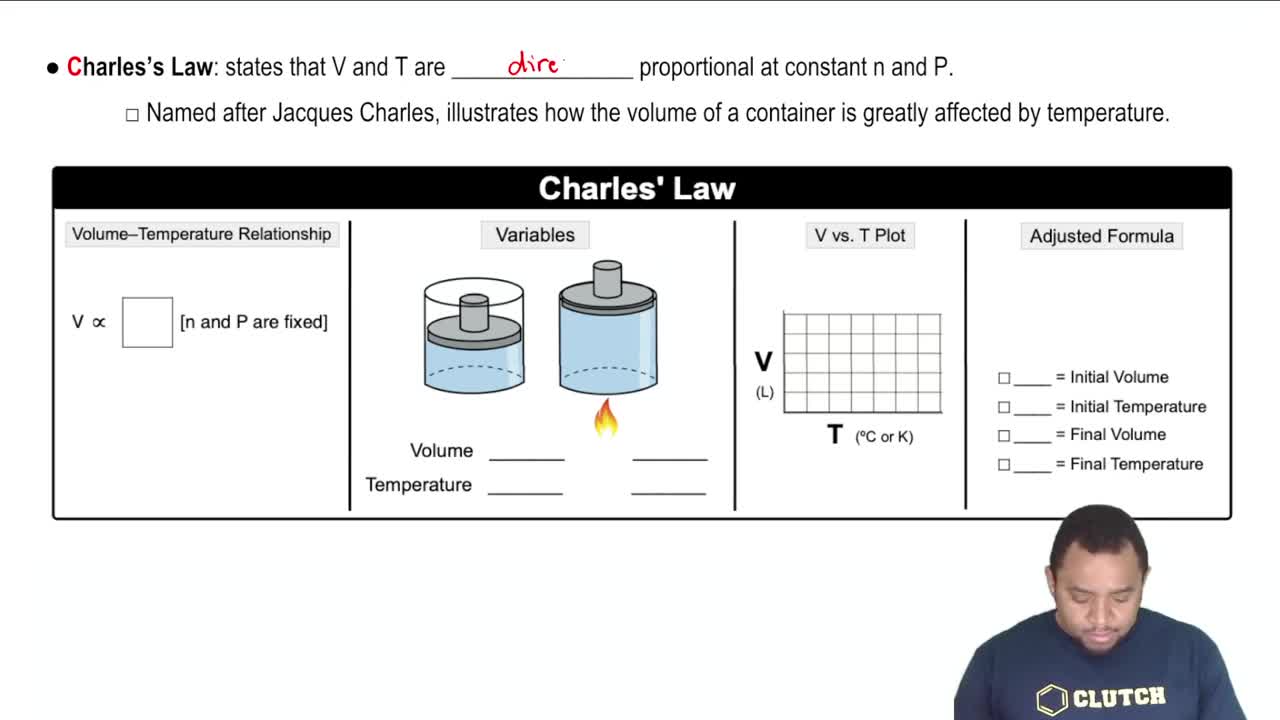
(a) Amonton's law expresses the relationship between pressure and temperature. Use Charles's law and Boyle's law to derive the proportionality relationship between P and T.
939
views

 Guida verificata passo dopo passo

 01:15
01:15
 02:06
02:06 01:08
01:08(a) Amonton's law expresses the relationship between pressure and temperature. Use Charles's law and Boyle's law to derive the proportionality relationship between P and T.
If the atmospheric pressure is 0.995 atm, what is the pressure of the enclosed gas in each of the three cases depicted in the drawing? Assume that the gray liquid is mercury. (ii)
An open-end manometer containing mercury is connected to a container of gas, as depicted in Sample Exercise 10.2. What is the pressure of the enclosed gas in torr in each of the following situations? (a) The mercury in the arm attached to the gas is 15.4 mm higher than in the one open to the atmosphere; atmospheric pressure is 0.985 atm.
If the atmospheric pressure is 0.995 atm, what is the pressure of the enclosed gas in each of the three cases depicted in the drawing? Assume that the gray liquid is mercury. (i)
You have a gas at 25 C confined to a cylinder with a movable piston. Which of the following actions would double the gas pressure? (a) Lifting up on the piston to double the volume while keeping the temperature constant (b) Heating the gas so that its temperature rises from 25 C to 50 C, while keeping the volume constant (c) Pushing down on the piston to halve the volume while keeping the temperature constant.