Ch.10 - Gases
Brown - Chemistry: The Central Science 15th Edition
Brown15th EditionChemistry: The Central ScienceISBN: 9780137542970Non è quello che usi tu?Cambia libro di testo
Capitolo 10, Problema 79b,c,d

The temperature of a 5.00-L container of N2 gas is increased from 20 °C to 250 °C. If the volume is held constant, predict qualitatively how this change affects the following: (b) the rootmean-square speed of the molecules. (c) the strength of the impact of an average molecule with the container walls. (d) the total number of collisions of molecules with walls per second.

Guida verificata passo dopo passo
1
Identify the relationship between temperature and root-mean-square speed. The root-mean-square speed (v_{rms}) of gas molecules is given by the equation v_{rms} = \(\sqrt{\frac{3kT}{m}\)}, where k is the Boltzmann constant, T is the temperature in Kelvin, and m is the molar mass of the gas.
Convert the initial and final temperatures from Celsius to Kelvin. Remember that K = °C + 273.15.
Understand that the volume of the container is constant, so the only variable changing that affects v_{rms} is the temperature T.
Analyze the equation for v_{rms}. Since T appears inside a square root in the numerator, an increase in T will lead to an increase in v_{rms}.
Conclude qualitatively that as the temperature increases from 20 °C to 250 °C, the root-mean-square speed of the nitrogen molecules will increase.

Risposta video verificata per un problema simile:

Questa soluzione video è stata consigliata dai nostri tutor come utile per risolvere questo problema.
Durata del video:
1m

Concetti chiave

Ecco i concetti essenziali che devi comprendere per rispondere correttamente alla domanda.

Root Mean Square Speed

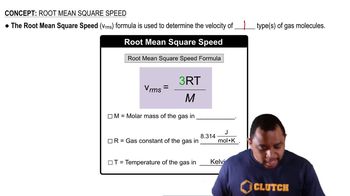
The root mean square speed (rms speed) of gas molecules is a measure of the average speed of particles in a gas. It is calculated using the formula v_rms = √(3RT/M), where R is the gas constant, T is the absolute temperature in Kelvin, and M is the molar mass of the gas. As temperature increases, the rms speed also increases, indicating that gas molecules move faster at higher temperatures.
Video consigliato:
Percorso guidato
01:05
Root Mean Square Speed Formula

Kinetic Molecular Theory

Kinetic Molecular Theory explains the behavior of gases in terms of the motion of their molecules. It posits that gas particles are in constant, random motion and that their kinetic energy is directly proportional to the temperature of the gas. Therefore, an increase in temperature results in an increase in the average kinetic energy of the molecules, leading to higher speeds.
Video consigliato:
Percorso guidato
01:19
Kinetic Molecular Theory

Effect of Temperature on Gas Behavior

In thermodynamics, temperature is a measure of the average kinetic energy of particles in a substance. For gases, when the temperature rises, the energy of the molecules increases, causing them to collide more forcefully and move more rapidly. This relationship is crucial for predicting how changes in temperature affect properties like speed and pressure in a gas.
Video consigliato:
Percorso guidato
02:31
Photoelectric Effect