Ch.13 - Properties of Solutions
Brown - Chemistry: The Central Science 15th Edition
Brown15th EditionChemistry: The Central ScienceISBN: 9780137542970Non è quello che usi tu?Cambia libro di testo
Capitolo 13, Problema 52b,c

Calculate the number of moles of solute present in each of the following solutions: (b) 50.0 mg of an aqueous solution that is 1.50 m NaCl, (c) 75.0 g of an aqueous solution that is 1.50% sucrose (C12H22O11) by mass.

Guida verificata passo dopo passo
1
To find the number of moles of solute in a solution, we need to understand the concentration terms given. For part (b), the concentration is given in molality (m), which is moles of solute per kilogram of solvent.
For part (b), first convert the mass of the solution from milligrams to grams: 50.0 mg = 0.0500 g. Since molality is based on the mass of the solvent, we need to find the mass of the solvent. Assume the density of the solution is similar to water, so the mass of the solvent is approximately the mass of the solution.
Use the formula for molality: \( m = \frac{\text{moles of solute}}{\text{kg of solvent}} \). Rearrange to find moles of solute: \( \text{moles of solute} = m \times \text{kg of solvent} \). Convert the mass of the solvent to kilograms and multiply by the molality to find the moles of NaCl.
For part (c), the concentration is given as a percentage by mass. This means 1.50% of the solution's mass is sucrose. Calculate the mass of sucrose in the solution: \( \text{mass of sucrose} = \frac{1.50}{100} \times 75.0 \text{ g} \).
Convert the mass of sucrose to moles using its molar mass. The molar mass of sucrose (C12H22O11) is calculated by adding the atomic masses of all the atoms in the formula: \( 12 \times 12.01 + 22 \times 1.01 + 11 \times 16.00 \). Use this molar mass to convert the mass of sucrose to moles: \( \text{moles of sucrose} = \frac{\text{mass of sucrose}}{\text{molar mass of sucrose}} \).

Concetti chiave

Ecco i concetti essenziali che devi comprendere per rispondere correttamente alla domanda.

Molarity

Molarity (M) is a measure of concentration defined as the number of moles of solute per liter of solution. It is crucial for calculating the amount of solute in a given volume of solution. In this question, the molarity of NaCl is given as 1.50 m, which indicates that there are 1.50 moles of NaCl in every liter of solution.
Video consigliato:

Mass Percent Concentration

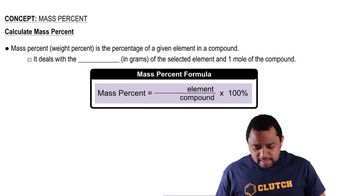
Mass percent concentration is a way to express the concentration of a solute in a solution, calculated as the mass of the solute divided by the total mass of the solution, multiplied by 100. For the sucrose solution, a 1.50% concentration means that there are 1.50 grams of sucrose in every 100 grams of solution, which is essential for determining the number of moles of sucrose present.
Video consigliato:
Percorso guidato
00:38
Mass Percent Calculation

Moles and Molar Mass

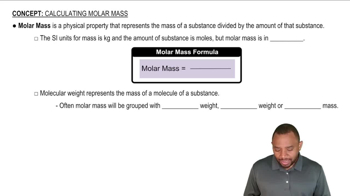
A mole is a unit in chemistry that represents 6.022 x 10²³ entities (Avogadro's number), and it is used to quantify the amount of substance. To convert grams of a substance to moles, one must divide the mass by the molar mass (the mass of one mole of the substance). This concept is vital for calculating the number of moles of solute in both the NaCl and sucrose solutions.
Video consigliato:
Percorso guidato
02:11
Molar Mass Concept