
Ch.18 - Chemistry of the Environment
Brown - Chemistry: The Central Science 15th Edition
Brown15th EditionChemistry: The Central ScienceISBN: 9780137542970Non è quello che usi tu?Cambia libro di testo
Capitolo 18, Problema 4

Where does the energy come from to evaporate the esti- mated 425,000 km3 of water that annually leaves the oceans, as illustrated here? [Section 18.3]

Guida verificata passo dopo passo
1
Understand that the energy required for evaporation comes from the sun, which provides the heat necessary to convert liquid water into water vapor.
Recognize that the process of evaporation involves breaking the intermolecular forces between water molecules, which requires energy.
Consider that the sun's energy is absorbed by the ocean's surface, increasing the kinetic energy of water molecules, allowing them to escape into the atmosphere as vapor.
Acknowledge that this process is part of the water cycle, where solar energy drives the evaporation of water from the ocean's surface.
Note that the energy involved in this process is often measured in terms of the heat of vaporization, which is the amount of energy required to convert a given amount of liquid into vapor.

Risposta video verificata per un problema simile:

Questa soluzione video è stata consigliata dai nostri tutor come utile per risolvere questo problema.
Durata del video:
53s

Concetti chiave

Ecco i concetti essenziali che devi comprendere per rispondere correttamente alla domanda.

Evaporation

Evaporation is the process by which liquid water transforms into vapor, occurring at the surface of the liquid. This phase change requires energy, typically in the form of heat, which is absorbed from the surrounding environment. Factors such as temperature, humidity, and wind speed influence the rate of evaporation, making it a critical component of the water cycle.
Video consigliato:
Percorso guidato
04:50
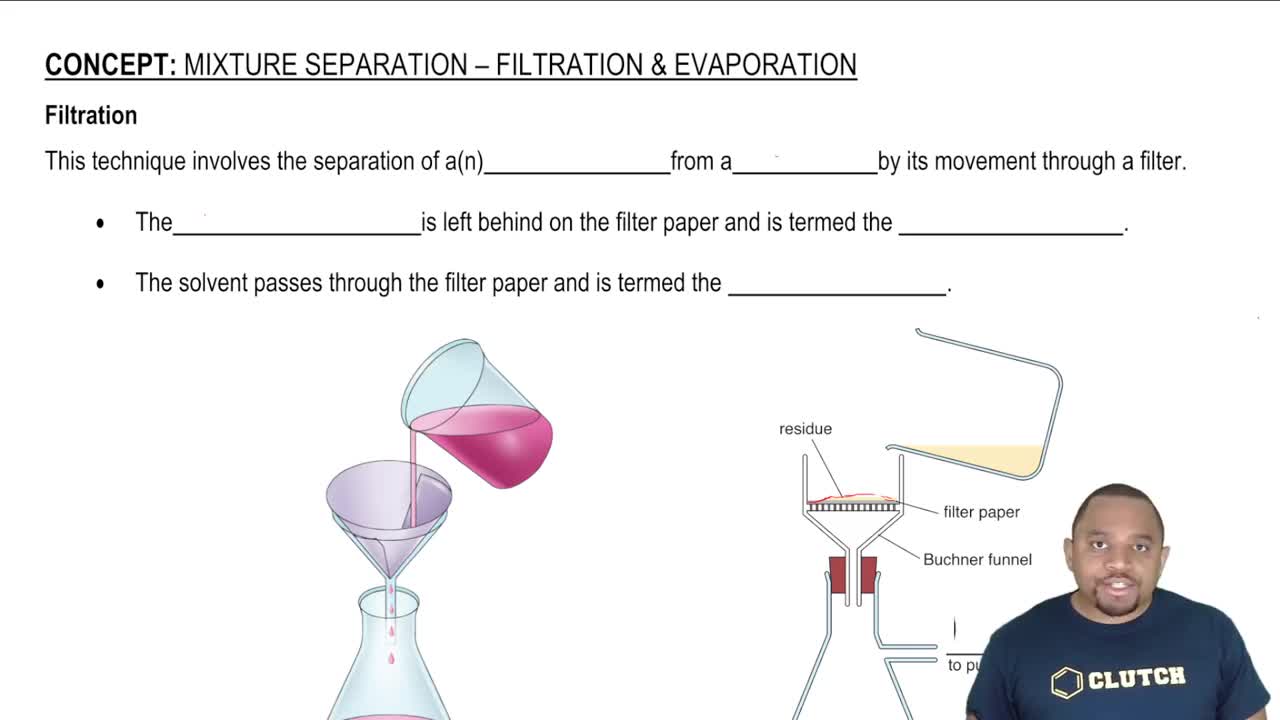
Filtration and Evaporation

Energy Sources for Evaporation

The energy required for evaporation primarily comes from solar radiation, which heats the surface of the oceans. This energy increases the kinetic energy of water molecules, allowing them to overcome intermolecular forces and escape into the atmosphere as vapor. Additionally, heat from the atmosphere and ocean currents can also contribute to the energy needed for this process.
Video consigliato:
Percorso guidato
04:50
Filtration and Evaporation

Water Cycle

The water cycle describes the continuous movement of water within the Earth and atmosphere, encompassing processes such as evaporation, condensation, precipitation, and runoff. Evaporation plays a vital role in this cycle, as it transfers water from the oceans to the atmosphere, where it can later condense and fall back to the surface as precipitation, thus sustaining ecosystems and weather patterns.
Video consigliato:
Percorso guidato
03:49
Born Haber Cycle