Ch.19 - Chemical Thermodynamics
Brown - Chemistry: The Central Science 15th Edition
Brown15th EditionChemistry: The Central ScienceISBN: 9780137542970Non è quello che usi tu?Cambia libro di testo
Capitolo 19, Problema 15b

Consider the vaporization of liquid water to steam at a pressure of 1 atm. (b) In what temperature range is it a spontaneous process?

Guida verificata passo dopo passo
1
insert step 1> Identify the process: The vaporization of liquid water to steam is an endothermic process, meaning it requires heat input.
insert step 2> Understand spontaneity: A process is spontaneous if the change in Gibbs free energy (\( \Delta G \)) is negative.
insert step 3> Use the Gibbs free energy equation: \( \Delta G = \Delta H - T\Delta S \), where \( \Delta H \) is the enthalpy change, \( T \) is the temperature in Kelvin, and \( \Delta S \) is the entropy change.
insert step 4> Determine the conditions for spontaneity: For the process to be spontaneous, \( \Delta G < 0 \). This implies \( T\Delta S > \Delta H \).
insert step 5> Calculate the temperature range: Rearrange the inequality to find the temperature range where the process is spontaneous: \( T > \frac{\Delta H}{\Delta S} \). Use the known values of \( \Delta H \) and \( \Delta S \) for water vaporization at 1 atm to find the temperature range.

Risposta video verificata per un problema simile:

Questa soluzione video è stata consigliata dai nostri tutor come utile per risolvere questo problema.
Durata del video:
1m

Concetti chiave

Ecco i concetti essenziali che devi comprendere per rispondere correttamente alla domanda.

Vaporization

Vaporization is the process by which a liquid turns into a gas. For water, this occurs when molecules gain enough energy to overcome intermolecular forces. At 1 atm pressure, water vaporizes at 100°C, but the spontaneity of this process depends on temperature and the Gibbs free energy change.
Video consigliato:
Percorso guidato
02:40
Raoult's Law and Vapor Pressure

Gibbs Free Energy

Gibbs free energy (G) is a thermodynamic potential that helps predict the spontaneity of a process at constant temperature and pressure. A process is spontaneous when the change in Gibbs free energy (ΔG) is negative. For vaporization, ΔG can be influenced by temperature, pressure, and the enthalpy and entropy changes associated with the phase transition.
Video consigliato:
Percorso guidato
01:51
Gibbs Free Energy of Reactions

Phase Equilibrium

Phase equilibrium occurs when the rates of vaporization and condensation are equal, resulting in a stable state. At 1 atm, water and steam coexist at 100°C. Above this temperature, vaporization becomes spontaneous as the system favors the gaseous phase, while below it, condensation is favored, indicating the importance of temperature in determining the spontaneity of vaporization.
Video consigliato:
Percorso guidato
03:22
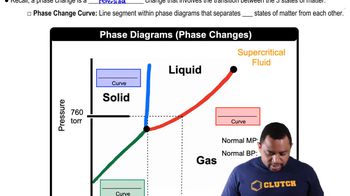
Phase Changes in Diagrams