By using the data in Appendix E, determine whether each of the following substances is likely to serve as an oxidant or a reductant: (a) Cl2(g), (b) MnO4- (aq, acidic solution), (c) Ba(s)
Ch.20 - Electrochemistry

Brown15th EditionChemistry: The Central ScienceISBN: 9780137542970Non è quello che usi tu?Cambia libro di testo
Capitolo 20, Problema 46
A voltaic cell consists of a strip of cadmium metal in a solution of Cd(NO3)2 in one beaker, and in the other beaker a platinum electrode is immersed in a NaCl solution, with Cl2 gas bubbled around the electrode. A salt bridge connects the two beakers. (a) Which electrode serves as the anode, and which as the cathode? (b) Does the Cd electrode gain or lose mass as the cell reaction proceeds? (c) Write the equation for the overall cell reaction.
Guida verificata passo dopo passo1
Identify the oxidation and reduction half-reactions. In the cadmium beaker, cadmium will undergo oxidation, losing electrons. In the platinum electrode beaker, chlorine gas (Cl2) will undergo reduction, gaining electrons.
Write the half-reaction for the cadmium electrode: Cd(s) → Cd^{2+}(aq) + 2e^{-}. This indicates that cadmium metal is oxidized to cadmium ions while releasing two electrons.
Write the half-reaction for the platinum electrode: Cl2(g) + 2e^{-} → 2Cl^{-}(aq). This shows that chlorine gas is reduced to chloride ions by gaining two electrons.
Combine the two half-reactions to form the overall cell reaction. Ensure that the number of electrons lost in the oxidation half-reaction equals the number of electrons gained in the reduction half-reaction.
The overall cell reaction is: Cd(s) + Cl2(g) → Cd^{2+}(aq) + 2Cl^{-}(aq). This equation represents the net process occurring in the voltaic cell, where cadmium is oxidized and chlorine is reduced.

Risposta video verificata per un problema simile:
Questa soluzione video è stata consigliata dai nostri tutor come utile per risolvere questo problema.
Durata del video:
7mConcetti chiave
Ecco i concetti essenziali che devi comprendere per rispondere correttamente alla domanda.
Voltaic Cell
A voltaic cell, also known as a galvanic cell, is an electrochemical cell that converts chemical energy into electrical energy through spontaneous redox reactions. It consists of two half-cells, each containing an electrode and an electrolyte, connected by a salt bridge that allows ion flow while preventing the mixing of different solutions.
Video consigliato:
Percorso guidato
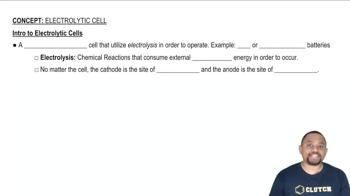
The Electrolytic Cell
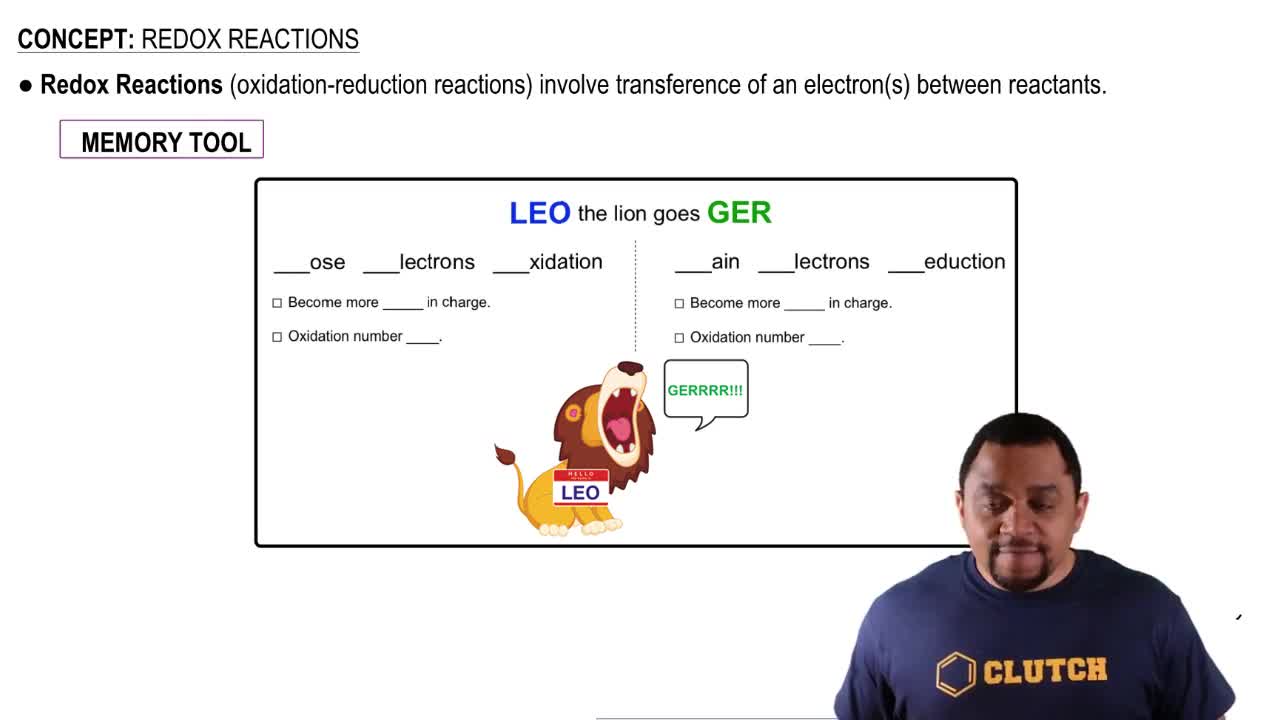
Oxidation and Reduction
Oxidation and reduction are fundamental concepts in redox reactions. Oxidation refers to the loss of electrons by a substance, while reduction refers to the gain of electrons. In a voltaic cell, one electrode undergoes oxidation (anode) and the other undergoes reduction (cathode), leading to the flow of electrons through an external circuit.
Video consigliato:
Percorso guidato
Oxidation and Reduction Reactions
Cell Reaction Equation
The overall cell reaction equation represents the combined oxidation and reduction half-reactions occurring in a voltaic cell. It is derived by balancing the number of electrons lost in oxidation with those gained in reduction, resulting in a stoichiometric equation that reflects the reactants and products involved in the electrochemical process.
Video consigliato:
Percorso guidato
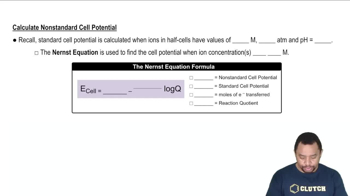
The Nernst Equation
Pratica correlata
Domanda del libro di testo
567
views
Domanda del libro di testo
The standard reduction potentials of the following halfreactions are given in Appendix E:
Ag+(aq) + e- → Ag(s)
Cu2+(aq) + 2 e- → Cu(s)
Ni2+(aq) + 2 e- → Ni(s)
Cr3+(aq) + 3 e- → Cr(s)
(a) Determine which combination of these half-cell reactions leads to the cell reaction with the largest positive cell potential and calculate the value.
(b) Determine which combination of these half-cell reactions leads to the cell reaction with the smallest positive cell potential and calculate the value.
964
views
Domanda del libro di testo
From each of the following pairs of substances, use data in Appendix E to choose the one that is the stronger reducing agent: (a) Fe(s) or Mg(s) (b) Ca(s) or Al(s) (c) H2(g, acidic solution) or H2S(g)
341
views