Ch.3 - Chemical Reactions and Reaction Stoichiometry
Brown - Chemistry: The Central Science 15th Edition
Brown15th EditionChemistry: The Central ScienceISBN: 9780137542970Non è quello che usi tu?Cambia libro di testo
Capitolo 3, Problema 26f

Calculate the percentage by mass of the indicated element in the following compounds: f. carbon in capsaicin, C18H27NO3, the compound that gives the hot taste to chili peppers.

Guida verificata passo dopo passo
1
Step 1: First, we need to calculate the molar mass of capsaicin, C18H27NO3. The molar mass of an element is the mass of one mole of that element. It is calculated by adding up the atomic masses of all the atoms in the compound. The atomic masses of carbon (C), hydrogen (H), nitrogen (N), and oxygen (O) are approximately 12.01 g/mol, 1.01 g/mol, 14.01 g/mol, and 16.00 g/mol, respectively.
Step 2: Multiply the atomic mass of each element by the number of atoms of that element in the compound. For capsaicin, this would be (18 atoms C * 12.01 g/mol C) + (27 atoms H * 1.01 g/mol H) + (1 atom N * 14.01 g/mol N) + (3 atoms O * 16.00 g/mol O).
Step 3: Add up all the values obtained in step 2 to get the molar mass of capsaicin.
Step 4: To find the percentage by mass of carbon in capsaicin, divide the total mass of carbon in one mole of capsaicin by the molar mass of capsaicin. This would be (18 atoms C * 12.01 g/mol C) / molar mass of capsaicin.
Step 5: Multiply the result from step 4 by 100% to get the percentage by mass of carbon in capsaicin.

Risposta video verificata per un problema simile:

Questa soluzione video è stata consigliata dai nostri tutor come utile per risolvere questo problema.
Durata del video:
2m

Concetti chiave

Ecco i concetti essenziali che devi comprendere per rispondere correttamente alla domanda.

Molar Mass Calculation

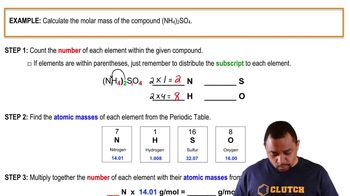
Molar mass is the mass of one mole of a substance, typically expressed in grams per mole (g/mol). To calculate the molar mass of a compound, sum the molar masses of all the atoms in its chemical formula. For capsaicin (C18H27NO3), this involves calculating the contributions from carbon, hydrogen, nitrogen, and oxygen based on their respective atomic masses.
Video consigliato:
Percorso guidato
03:12
Molar Mass Calculation Example

Percentage by Mass

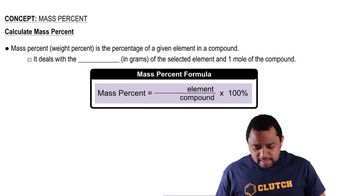
Percentage by mass is a way to express the concentration of an element within a compound. It is calculated by dividing the total mass of the element in the compound by the molar mass of the compound, then multiplying by 100. This provides a clear understanding of how much of the compound's mass is due to a specific element, such as carbon in capsaicin.
Video consigliato:
Percorso guidato
00:38
Mass Percent Calculation

Empirical and Molecular Formulas

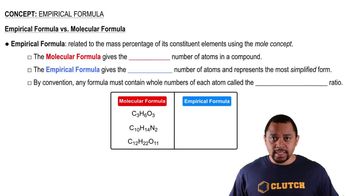
The empirical formula represents the simplest whole-number ratio of elements in a compound, while the molecular formula shows the actual number of each type of atom in a molecule. Capsaicin's molecular formula (C18H27NO3) indicates the exact number of carbon, hydrogen, nitrogen, and oxygen atoms, which is essential for calculating the mass percentage of carbon accurately.
Video consigliato:
Percorso guidato
02:26
Empirical vs Molecular Formula