
Ch.7 - Periodic Properties of the Elements
Brown - Chemistry: The Central Science 15th Edition
Brown15th EditionChemistry: The Central ScienceISBN: 9780137542970Non è quello che usi tu?Cambia libro di testo
Capitolo 7, Problema 18

Arrange the following atoms in order of increasing effective nuclear charge experienced by the electrons in the 𝑛=3 electron shell: K, Mg, P, Rh, Ti.

Guida verificata passo dopo passo
1
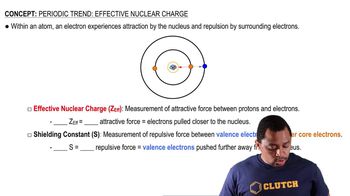
Understand the concept of effective nuclear charge (Z_eff), which is the net positive charge experienced by an electron in a multi-electron atom. It is calculated as Z_eff = Z - S, where Z is the atomic number and S is the shielding constant.
Identify the atomic numbers (Z) for each element: K (Z=19), Mg (Z=12), P (Z=15), Rh (Z=45), Ti (Z=22).
Consider the electron configuration of each element to determine the number of electrons in inner shells that contribute to shielding.
Recognize that electrons in the same shell (n=3) do not shield each other effectively, so focus on inner shell electrons for shielding.
Arrange the elements in order of increasing Z_eff by considering both the atomic number and the extent of shielding by inner electrons.

Risposta video verificata per un problema simile:

Questa soluzione video è stata consigliata dai nostri tutor come utile per risolvere questo problema.
Durata del video:
5m

Concetti chiave

Ecco i concetti essenziali che devi comprendere per rispondere correttamente alla domanda.

Effective Nuclear Charge (Z_eff)

Effective nuclear charge is the net positive charge experienced by an electron in a multi-electron atom. It accounts for the actual nuclear charge (the number of protons) and the shielding effect caused by inner-shell electrons. The greater the effective nuclear charge, the stronger the attraction between the nucleus and the outer electrons, influencing atomic size and ionization energy.
Video consigliato:
Percorso guidato
01:51
Effective Nuclear Charge

Shielding Effect

The shielding effect refers to the phenomenon where inner-shell electrons partially block the attraction between the nucleus and the outer-shell electrons. This results in a lower effective nuclear charge felt by the outer electrons. As the number of inner electrons increases, the shielding effect becomes more significant, reducing the effective nuclear charge experienced by the outermost electrons.
Video consigliato:
Percorso guidato
02:31
Photoelectric Effect

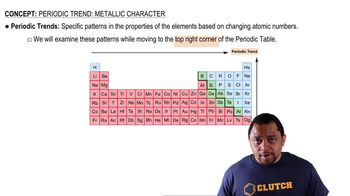
Trends in the Periodic Table

Trends in the periodic table, such as atomic size, ionization energy, and effective nuclear charge, are influenced by the arrangement of elements. As you move across a period from left to right, the effective nuclear charge generally increases due to the addition of protons without a corresponding increase in shielding. Conversely, moving down a group increases the number of electron shells, which enhances shielding and can decrease the effective nuclear charge felt by outer electrons.
Video consigliato:
Percorso guidato
00:38
Periodic Trends
Pratica correlata
Domanda del libro di testo

With the exception of helium, the noble gases condense to form solids when they are cooled sufficiently. At temperatures below 83 K, argon forms a close-packed solid whose structure is shown below. (c) Based on this comparison would you say that the atoms are held together by chemical bonds in solid argon?

601
views
Domanda del libro di testo

Which will experience the greater effective nuclear charge, the electrons in the 𝑛=3 shell in Ar or the 𝑛=3 shell in Kr? Which is more likely to be closer to the nucleus?

3
views
Domanda del libro di testo

Detailed calculations show that the value of Zeff for the outermost electrons in Na and K atoms is 2.51+ and 3.49+, respectively. (e) Predict Zeff for the outermost electrons in the Rb atom based on the calculations for Na and K.

1070
views
Domanda del libro di testo

With the exception of helium, the noble gases condense to form solids when they are cooled sufficiently. At temperatures below 83 K, argon forms a close-packed solid whose structure is shown below. (b) Is this value larger or smaller than the bonding atomic radius estimated for argon in Figure 7.7?

487
views
Domanda del libro di testo

Tungsten has the highest melting point of any metal in the periodic table: 3422°C. The distance between the centers of W atoms in tungsten metal is 2.74 Å. a. What is the atomic radius of a tungsten atom in this environment? (This radius is called the metallic radius.)

2
views
Domanda del libro di testo

Detailed calculations show that the value of Zeff for the outermost electrons in Si and Cl atoms is 4.29+ and 6.12+, respectively. (a) What value do you estimate for Zeff experienced by the outermost electron in both Si and Cl by assuming core electrons contribute 1.00 and valence electrons contribute 0.00 to the screening constant?

4097
views