Little is known about the properties of astatine, At, because of its rarity and high radioactivity. Nevertheless, it is possible for us to make many predictions about its properties. (c) What is the chemical formula of the compound it forms with Na?
Ch.7 - Periodic Properties of the Elements

Brown15th EditionChemistry: The Central ScienceISBN: 9780137542970Non è quello che usi tu?Cambia libro di testo
Capitolo 7, Problema 74b
Little is known about the properties of astatine, At, because of its rarity and high radioactivity. Nevertheless, it is possible for us to make many predictions about its properties. (b) Would you expect At to be a metal, nonmetal, or metalloid? Explain.
Guida verificata passo dopo passo1
Step 1: Identify the position of astatine (At) on the periodic table. Astatine is in Group 17, which is also known as the halogens.
Step 2: Understand the general properties of elements in Group 17. Halogens are typically nonmetals, which means they tend to gain electrons in chemical reactions and have high electronegativities and ionization energies.
Step 3: Consider the trend in metallic character across a period. As you move from left to right across a period on the periodic table, the metallic character of the elements decreases. This is because the number of protons in the nucleus increases, pulling the electrons closer to the nucleus and making it harder for the atom to lose an electron and exhibit metallic properties.
Step 4: Combine the information from steps 2 and 3. Given that astatine is a halogen and is located on the right side of the periodic table, it is expected to behave as a nonmetal.
Step 5: However, keep in mind that astatine is also the heaviest halogen, and heavier elements can sometimes display properties that deviate from the trends. Therefore, while it is most likely a nonmetal, it could potentially display some metalloid properties.

Risposta video verificata per un problema simile:
Questa soluzione video è stata consigliata dai nostri tutor come utile per risolvere questo problema.
Durata del video:
2mConcetti chiave
Ecco i concetti essenziali che devi comprendere per rispondere correttamente alla domanda.
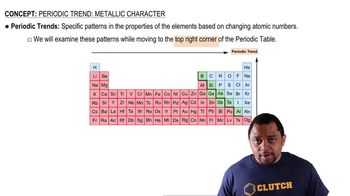
Periodic Trends
Periodic trends refer to the predictable patterns in the properties of elements as you move across or down the periodic table. These trends include atomic size, ionization energy, and electronegativity, which help in predicting whether an element is likely to behave as a metal, nonmetal, or metalloid based on its position in the table.
Video consigliato:
Percorso guidato
Periodic Trends
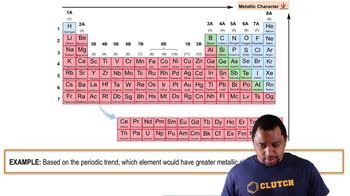
Metallic Character
Metallic character describes the tendency of an element to exhibit properties typical of metals, such as conductivity, malleability, and luster. Generally, metallic character increases as you move down a group in the periodic table and decreases across a period from left to right, influencing whether an element like astatine is expected to be metallic.
Video consigliato:
Percorso guidato
Metallic Character Example
Radioactivity and Stability
Radioactivity refers to the process by which unstable atomic nuclei lose energy by emitting radiation. Astatine is highly radioactive, which affects its stability and the types of chemical bonds it can form. Understanding the implications of radioactivity is crucial for predicting the behavior of astatine in chemical reactions and its classification as a metal, nonmetal, or metalloid.
Video consigliato:
Percorso guidato
Types of Radioactivity
Pratica correlata
Domanda del libro di testo
514
views
Domanda del libro di testo
Potassium and hydrogen react to form the ionic compound potassium hydride. (b) Use data in Figures 7.10 and 7.12 to determine the energy change in kJ/mol for the following two reactions:
K(g) + H(g) → K+(g) + H-(g)
K(g) + H(g) → K-(g) + H+(g)
1581
views
Domanda del libro di testo
Little is known about the properties of astatine, At, because of its rarity and high radioactivity. Nevertheless, it is possible for us to make many predictions about its properties. (a) Do you expect the element to be a gas, liquid, or solid at room temperature?
991
views
