Ch.10 - Gases: Their Properties & Behavior
McMurry - Chemistry 8th Edition
McMurry8th EditionChemistryISBN: 9781292336145Non è quello che usi tu?Cambia libro di testo
Capitolo 10, Problema 87

A 20.0-L flask contains 0.776 g of He and 3.61 g of CO2 at 300 K. (a) What is the partial pressure of He in mm Hg?

Guida verificata passo dopo passo
1
Calculate the number of moles of He using the ideal gas law formula: \( n = \frac{m}{M} \), where \( m \) is the mass of the gas and \( M \) is the molar mass of He (4.00 g/mol).
Use the ideal gas law \( PV = nRT \) to find the total pressure in the flask. Here, \( P \) is the pressure, \( V \) is the volume (20.0 L), \( n \) is the total moles of gas (sum of moles of He and CO2), \( R \) is the gas constant (0.0821 L atm/mol K), and \( T \) is the temperature (300 K).
Calculate the mole fraction of He, which is the ratio of moles of He to the total moles of gases in the flask.
Determine the partial pressure of He by multiplying the total pressure by the mole fraction of He.
Convert the partial pressure of He from atm to mm Hg by using the conversion factor (1 atm = 760 mm Hg).

Risposta video verificata per un problema simile:

Questa soluzione video è stata consigliata dai nostri tutor come utile per risolvere questo problema.
Durata del video:
4m

Concetti chiave

Ecco i concetti essenziali che devi comprendere per rispondere correttamente alla domanda.

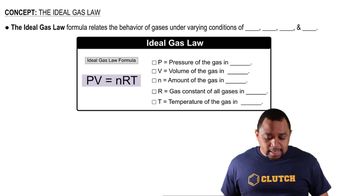
Ideal Gas Law

The Ideal Gas Law relates the pressure, volume, temperature, and number of moles of a gas through the equation PV = nRT. This law is fundamental for calculating the behavior of gases under various conditions, allowing us to determine the pressure exerted by a gas in a given volume at a specific temperature.
Video consigliato:
Percorso guidato
01:15
Ideal Gas Law Formula

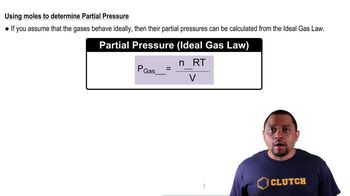
Partial Pressure

Partial pressure is the pressure that a single gas in a mixture would exert if it occupied the entire volume alone at the same temperature. According to Dalton's Law of Partial Pressures, the total pressure of a gas mixture is the sum of the partial pressures of each individual gas, which is crucial for solving problems involving multiple gases.
Video consigliato:
Percorso guidato
00:48
Partial Pressure Calculation

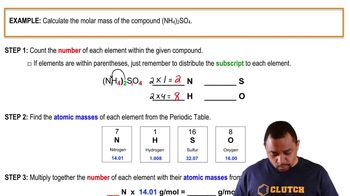
Molar Mass and Moles Calculation

To find the number of moles of a gas, the mass of the gas is divided by its molar mass. This calculation is essential for applying the Ideal Gas Law, as it allows us to convert the mass of the gases present (in grams) into moles, which are needed to determine the partial pressures of each gas in the mixture.
Video consigliato:
Percorso guidato
03:12
Molar Mass Calculation Example
Pratica correlata
Domanda del libro di testo

A mixture of 14.2 g of H2 and 36.7 g of Ar is placed in a 100.0-L container at 290 K. (b) What is the partial pressure of Ar in atmospheres?

422
views
Domanda del libro di testo

Chlorine gas was first prepared in 1774 by the oxidation of NaCl with MnO2: 2 NaCl(s) + 2 H2SO4(l) + MnO2(s) → Na2SO4(s) + MnSO4(s) + 2 H2O(g) + Cl2(g) Assume that the gas produced is saturated with water vapor at a partial pressure of 28.7 mm Hg and that it has a volume of 0.597 L at 27 °C and 755 mm Hg pressure. (b) How many grams of NaCl were used in the experiment, assuming complete reaction?

604
views
Domanda del libro di testo

A mixture of 14.2 g of H2 and 36.7 g of Ar is placed in a 100.0-L container at 290 K. (a) What is the partial pressure of H2 in atmospheres?

726
views
Domanda del libro di testo

Chlorine gas was first prepared in 1774 by the oxidation of NaCl with MnO2: 2 NaCl(s) + 2 H2SO4(l) + MnO2(s) → Na2SO4(s) + MnSO4(s) + 2 H2O(g) + Cl2(g) Assume that the gas produced is saturated with water vapor at a partial pressure of 28.7 mm Hg and that it has a volume of 0.597 L at 27 °C and 755 mm Hg pressure. (a) What is the mole fraction of Cl2 in the gas?

380
views
Domanda del libro di testo
A sample of magnesium metal reacts with aqueous HCl to yield H2 gas: Mg1s2 + 2 HCl1aq2¡MgCl21aq2 + H21g2 The gas that forms is found to have a volume of 3.557 L at 25 °C and a pressure of 747 mm Hg. Assuming that the gas is saturated with water vapor at a partial pressure of 23.8 mm Hg, what is the partial pressure in millimeters of mercury of the H2? How many grams of magnesium metal were used in the reaction?
1183
views