Ch.10 - Gases: Their Properties & Behavior
McMurry - Chemistry 8th Edition
McMurry8th EditionChemistryISBN: 9781292336145Non è quello che usi tu?Cambia libro di testo
Capitolo 10, Problema 145c

An empty 4.00-L steel vessel is filled with 1.00 atm of CH4(g) and 4.00 atm of O2(g) at 300 °C. A spark causes the CH4 to burn completely, according to the equation
CH4(g) + 2 O2(g) → CO2(g) + 2 H2O(g) ΔH° = -802 kJ
(c) What is the partial pressure of CO2(g) in the vessel after combustion?

Guida verificata passo dopo passo
1
Identify the balanced chemical equation for the combustion of methane: CH4(g) + 2 O2(g) → CO2(g) + 2 H2O(g). This equation shows that one mole of CH4 reacts with two moles of O2 to produce one mole of CO2 and two moles of H2O.
Determine the initial moles of CH4 and O2 using the ideal gas law, PV = nRT. Given that the pressure (P) of CH4 is 1.00 atm and the volume (V) is 4.00 L, calculate the moles of CH4. Similarly, calculate the moles of O2 using its initial pressure of 4.00 atm.
Use stoichiometry to find the limiting reactant. Compare the mole ratio of CH4 to O2 from the balanced equation with the initial moles calculated. The reactant that produces the least amount of product is the limiting reactant.
Calculate the moles of CO2 produced using the stoichiometry of the reaction. Since the limiting reactant determines the amount of product formed, use the mole ratio from the balanced equation to find the moles of CO2.
Determine the partial pressure of CO2 using the ideal gas law. With the moles of CO2 calculated and the volume and temperature of the vessel known, apply the ideal gas law to find the partial pressure of CO2 in the vessel after combustion.

Risposta video verificata per un problema simile:

Questa soluzione video è stata consigliata dai nostri tutor come utile per risolvere questo problema.
Durata del video:
6m

Concetti chiave

Ecco i concetti essenziali che devi comprendere per rispondere correttamente alla domanda.

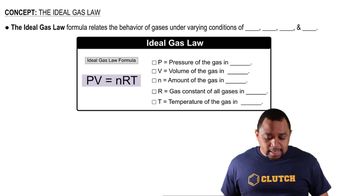
Ideal Gas Law

The Ideal Gas Law relates the pressure, volume, temperature, and number of moles of a gas through the equation PV = nRT. This law is essential for understanding how gases behave under different conditions and is crucial for calculating changes in pressure and volume during chemical reactions.
Video consigliato:
Percorso guidato
01:15
Ideal Gas Law Formula

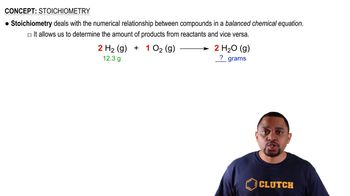
Stoichiometry

Stoichiometry involves the calculation of reactants and products in chemical reactions based on balanced chemical equations. In this case, it helps determine the amount of CO2 produced from the complete combustion of CH4, allowing for the calculation of its partial pressure after the reaction.
Video consigliato:
Percorso guidato
01:16
Stoichiometry Concept

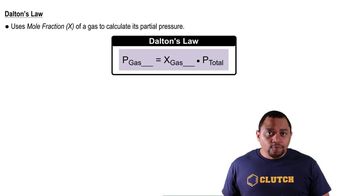
Dalton's Law of Partial Pressures

Dalton's Law states that in a mixture of gases, the total pressure is equal to the sum of the partial pressures of each individual gas. This principle is vital for determining the partial pressure of CO2 after the combustion of CH4, as it allows us to account for the contributions of all gases present in the vessel.
Video consigliato:
Percorso guidato
00:27
Dalton's Law and Partial Pressure