Ch.10 - Gases: Their Properties & Behavior
McMurry - Chemistry 8th Edition
McMurry8th EditionChemistryISBN: 9781292336145Non è quello che usi tu?Cambia libro di testo
Capitolo 10, Problema 67

What is the density in g/L of a gas mixture that contains 27.0% F2 and 73.0% He by volume at 714 mm Hg and 27.5 °C?

Guida verificata passo dopo passo
1
Convert the temperature from Celsius to Kelvin by using the formula: T(K) = T(°C) + 273.15.
Use the ideal gas law equation, PV = nRT, to find the total number of moles of the gas mixture. Rearrange the equation to solve for n (number of moles): n = \(\frac{PV}{RT}\).
Calculate the partial pressures of F2 and He using their volume percentages and the total pressure. For each gas, use the formula: P_{gas} = \(\frac{percentage}{100}\) \(\times\) total\_pressure.
Using the ideal gas law again, calculate the number of moles for each gas separately using their partial pressures. For each gas, use n_{gas} = \(\frac{P_{gas}\)V}{RT}.
Find the total mass of the gas mixture by adding the masses of F2 and He, calculated from their moles and molar masses. Then, calculate the density of the gas mixture using the formula: density = \(\frac{total\_mass}{volume}\).

Risposta video verificata per un problema simile:

Questa soluzione video è stata consigliata dai nostri tutor come utile per risolvere questo problema.
Durata del video:
9m

Concetti chiave

Ecco i concetti essenziali che devi comprendere per rispondere correttamente alla domanda.

Density of Gases

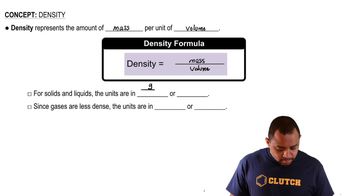
Density is defined as mass per unit volume. For gases, density can be expressed in grams per liter (g/L). The density of a gas can be calculated using the ideal gas law, which relates pressure, volume, temperature, and the number of moles of gas. Understanding how to manipulate this relationship is crucial for solving density-related problems.
Video consigliato:
Percorso guidato
01:56
Density Concepts

Partial Pressure and Dalton's Law

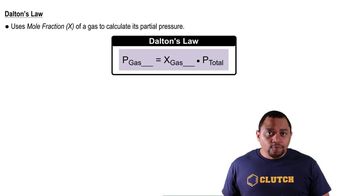
Dalton's Law states that in a mixture of gases, the total pressure is equal to the sum of the partial pressures of each individual gas. The partial pressure of a gas can be calculated by multiplying its mole fraction by the total pressure. This concept is essential for determining the contribution of each gas in a mixture to the overall density.
Video consigliato:
Percorso guidato
00:27
Dalton's Law and Partial Pressure

Ideal Gas Law

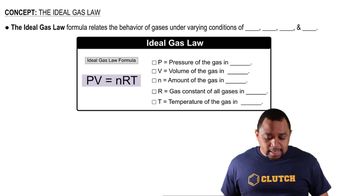
The Ideal Gas Law is a fundamental equation in chemistry, expressed as PV = nRT, where P is pressure, V is volume, n is the number of moles, R is the ideal gas constant, and T is temperature in Kelvin. This law allows for the calculation of various properties of gases, including density, by rearranging the equation to solve for the desired variable. It is particularly useful in problems involving gas mixtures.
Video consigliato:
Percorso guidato
01:15
Ideal Gas Law Formula