
Ch.11 - Liquids & Phase Changes
McMurry - Chemistry 8th Edition
McMurry8th EditionChemistryISBN: 9781292336145Non è quello che usi tu?Cambia libro di testo
Capitolo 11, Problema 31

The following diagram shows a close-up view of part of the vapor-pressure curves for a solvent (red curve) and a solution of the solvent with a second liquid (green curve). Is the second liquid more volatile or less volatile than the solvent? Graph showing vapor-pressure curves for a solvent (red) and a solution (green) against temperature.

Guida verificata passo dopo passo
1
Identify the vapor-pressure curves for the solvent (red curve) and the solution (green curve) on the graph.
Understand that vapor pressure is the pressure exerted by a vapor in equilibrium with its liquid phase at a given temperature.
Note that a higher vapor pressure at a given temperature indicates a more volatile substance.
Compare the vapor pressures of the solvent and the solution at the same temperature.
Conclude that since the vapor pressure of the solution (green curve) is lower than that of the solvent (red curve) at the same temperature, the second liquid in the solution is less volatile than the solvent.

Risposta video verificata per un problema simile:

Questa soluzione video è stata consigliata dai nostri tutor come utile per risolvere questo problema.
Durata del video:
2m

Concetti chiave

Ecco i concetti essenziali che devi comprendere per rispondere correttamente alla domanda.

Vapor Pressure

Vapor pressure is the pressure exerted by a vapor in equilibrium with its liquid or solid phase at a given temperature. It reflects the tendency of particles to escape from the liquid phase into the vapor phase. A higher vapor pressure indicates a greater volatility, meaning the substance evaporates more readily.
Video consigliato:
Percorso guidato
02:40
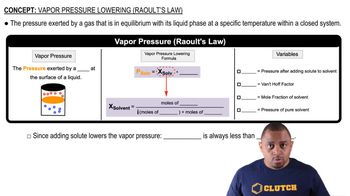
Raoult's Law and Vapor Pressure

Volatility

Volatility refers to how easily a substance vaporizes. A volatile liquid has a high vapor pressure at a given temperature, indicating that it can transition to the gas phase quickly. In the context of the question, comparing the vapor pressures of the solvent and the solution helps determine which component is more volatile.
Video consigliato:
Percorso guidato
02:50
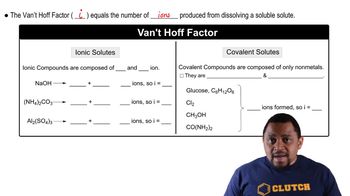
Van't Hoff Factor

Raoult's Law

Raoult's Law states that the vapor pressure of a solvent in a solution is directly proportional to the mole fraction of the solvent present. When a non-volatile solute is added to a solvent, the vapor pressure of the solvent decreases, indicating that the solution has a lower vapor pressure than the pure solvent, which can help infer the volatility of the second liquid.
Video consigliato:
Percorso guidato
02:40
Raoult's Law and Vapor Pressure
Pratica correlata
Domanda del libro di testo
Choose any two temperatures and corresponding vapor pressures in the table given in Problem 11.30, and use those values to calculate ΔHvap for dichloromethane in kJ/mol. How does the value you calculated compare to the value you read from your plot in Problem 11.32?
677
views
Domanda del libro di testo
The following phase diagram shows part of the liquid–vapor phase-transition boundaries for two solutions of equal con- centration, one containing a nonvolatile solute and the other containing a volatile solute whose vapor pressure at a given temperature is approximately half that of the pure solvent.

(d) Based on your drawing, what is the approximate normal boiling point of the pure solvent?
680
views
Domanda del libro di testo
Assume that you have a sample of gas at 350 K in a sealed container, as represented in (a). Which of the drawings (b)–(d) represents the gas after the temperature is lowered from 350 K to 150 K? The boiling point of the gas is 90 K.

525
views
Domanda del libro di testo
The dipole moment of methanol is m = 1.70 D. Use arrows to indicate the direction in which electrons are displaced.

1522
views
Domanda del libro di testo
Dichloromethane, CH2Cl2, is an organic solvent used for removing caffeine from coffee beans. The following table gives the vapor pressure of dichloromethane at various tem- peratures. Fill in the rest of the table, and use the data to plot curves of Pvap versus T and ln Pvap versus 1/T.
702
views
Domanda del libro di testo
What is the vapor pressure of SiCl4 in mm Hg at 30.0 °C? (See Problem 11.27.)
723
views