

Ch.14 - Chemical Kinetics
McMurry - Chemistry 8th Edition
McMurry8th EditionChemistryISBN: 9781292336145Non è quello che usi tu?Cambia libro di testo
Capitolo 14, Problema 138

A 1.50 L sample of gaseous HI having a density of 0.0101 g>cm3 is heated at 410 °C. As time passes, the HI decomposes to gaseous H2 and I2. The rate law is -Δ3HI4>Δt = k3HI42, where k = 0.031>1M ~ min2 at 410 °C. (b) What is the partial pressure of H2 after a reaction time of 8.00 h?

Guida verificata passo dopo passo
1
Convert the density of HI from g/cm³ to g/L by multiplying by 1000.
Calculate the initial mass of HI using the density and volume of the gas sample.
Determine the initial moles of HI using its molar mass (HI = 127.91 g/mol).
Use the rate law \(-\frac{d[HI]}{dt} = k[HI]^2\) to set up the integrated rate equation for a second-order reaction: \(\frac{1}{[HI]_t} = \frac{1}{[HI]_0} + kt\).
Solve for \([HI]_t\) after 8.00 hours, then use stoichiometry to find the moles of \(H_2\) produced, and finally use the ideal gas law \(PV = nRT\) to find the partial pressure of \(H_2\).

Risposta video verificata per un problema simile:

Questa soluzione video è stata consigliata dai nostri tutor come utile per risolvere questo problema.
Durata del video:
6m

Concetti chiave

Ecco i concetti essenziali che devi comprendere per rispondere correttamente alla domanda.

Ideal Gas Law

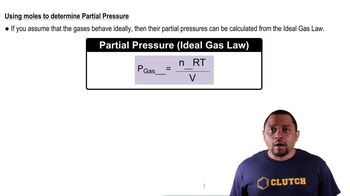
The Ideal Gas Law relates the pressure, volume, temperature, and number of moles of a gas through the equation PV = nRT. This law is essential for calculating the partial pressures of gases in a mixture, as it allows us to determine how changes in temperature and volume affect gas behavior. Understanding this law is crucial for solving problems involving gaseous reactions and their products.
Video consigliato:
Percorso guidato
01:15
Ideal Gas Law Formula

Rate Law and Reaction Kinetics

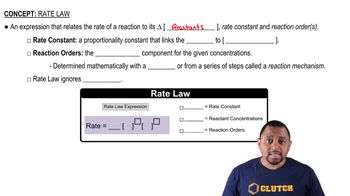
The rate law expresses the relationship between the rate of a chemical reaction and the concentration of its reactants. In this case, the rate law is given as -Δ[HI]/Δt = k[HI]^2, indicating that the rate depends on the square of the concentration of HI. Understanding how to apply the rate law is vital for determining how the concentration of reactants changes over time and how this affects the formation of products like H2.
Video consigliato:
Percorso guidato
01:52
Rate Law Fundamentals

Partial Pressure

Partial pressure is the pressure exerted by a single component of a gas mixture. According to Dalton's Law of Partial Pressures, the total pressure of a gas mixture is the sum of the partial pressures of each individual gas. In this problem, calculating the partial pressure of H2 after the reaction involves understanding how the decomposition of HI affects the amounts of H2 and I2 produced, which can be derived from the stoichiometry of the reaction.
Video consigliato:
Percorso guidato
00:48
Partial Pressure Calculation