
Ch.14 - Chemical Kinetics
McMurry - Chemistry 8th Edition
McMurry8th EditionChemistryISBN: 9781292336145Non è quello che usi tu?Cambia libro di testo
Capitolo 14, Problema 124b

Consider the reaction H2(g) + I2(g) → 2 HI(g). The reaction of a fixed amount of H2 and I2 is studied in a cylinder fitted with a movable piston. Indicate the effect of each of the following changes on the rate of the reaction. (b) An increase in volume at constant temperature

Guida verificata passo dopo passo
1
Understand that the rate of a reaction is influenced by the concentration of the reactants. According to the rate law, the rate is proportional to the concentration of the reactants raised to a power, which is determined experimentally.
Recognize that increasing the volume of the container at constant temperature will decrease the concentration of the gaseous reactants, H2 and I2, because concentration is defined as moles per unit volume.
Recall that a decrease in concentration of reactants generally leads to a decrease in the rate of reaction, as there are fewer molecules per unit volume to collide and react.
Consider the reaction mechanism and the collision theory, which states that reaction rate depends on the frequency of effective collisions between reactant molecules. A lower concentration results in fewer collisions per unit time.
Conclude that increasing the volume at constant temperature will decrease the rate of the reaction because it reduces the concentration of the reactants, leading to fewer effective collisions.

Concetti chiave

Ecco i concetti essenziali che devi comprendere per rispondere correttamente alla domanda.

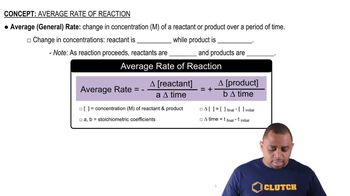
Reaction Rate

The reaction rate refers to the speed at which reactants are converted into products in a chemical reaction. It is influenced by several factors, including concentration, temperature, and the presence of catalysts. In gas-phase reactions, the concentration of reactants can be affected by changes in volume, which in turn impacts the frequency of collisions between molecules.
Video consigliato:
Percorso guidato
02:03
Average Rate of Reaction

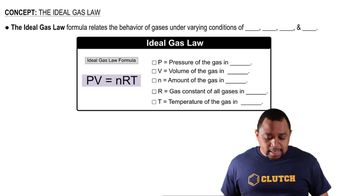
Ideal Gas Law

The Ideal Gas Law (PV = nRT) describes the relationship between pressure (P), volume (V), temperature (T), and the number of moles (n) of a gas. When the volume of a gas increases at constant temperature, the pressure decreases, which can lead to a change in the concentration of the gaseous reactants. Understanding this law is crucial for predicting how changes in volume affect reaction rates.
Video consigliato:
Percorso guidato
01:15
Ideal Gas Law Formula

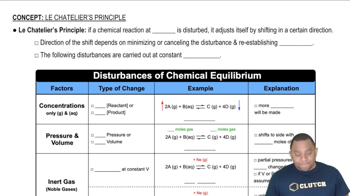
Le Chatelier's Principle

Le Chatelier's Principle states that if a dynamic equilibrium is disturbed by changing the conditions, the system will adjust to counteract the change and restore a new equilibrium. In the context of the reaction H2(g) + I2(g) → 2 HI(g), increasing the volume decreases the concentration of the reactants, which can shift the equilibrium position and potentially affect the rate of the forward reaction.
Video consigliato:
Percorso guidato
07:32
Le Chatelier's Principle