Ch.14 - Chemical Kinetics
McMurry - Chemistry 8th Edition
McMurry8th EditionChemistryISBN: 9781292336145Non è quello che usi tu?Cambia libro di testo
Capitolo 14, Problema 8

The gas phase decomposition of HI has the following rate law: 2 HI1g2¡H21g2 + I21g2 Rate = k3HI42 At 443 °C, k = 30.1 M-1 min-1. If the initial concentration of HI is 0.010 M, what is the concentration after 1.5 hours? (LO 14.8) (a) 6.9 * 10-3 M (b) 1.8 * 10-3 M (c) 3.6 * 10-4 M (d) 8.9 * 10-4 M

Guida verificata passo dopo passo
1
Identify the order of the reaction from the rate law. The rate law is given as Rate = k[HI]^2, indicating a second-order reaction with respect to HI.
Use the integrated rate law for a second-order reaction: \( \frac{1}{[A]_t} = kt + \frac{1}{[A]_0} \), where \([A]_t\) is the concentration at time t, \([A]_0\) is the initial concentration, and k is the rate constant.
Substitute the given values into the integrated rate law: \( \frac{1}{[HI]_t} = (30.1 \text{ M}^{-1} \text{ min}^{-1})(90 \text{ min}) + \frac{1}{0.010 \text{ M}} \). Note that 1.5 hours is converted to 90 minutes.
Solve for \([HI]_t\) by rearranging the equation: \([HI]_t = \frac{1}{(30.1 \times 90) + \frac{1}{0.010}}\).
Calculate \([HI]_t\) to find the concentration of HI after 1.5 hours.

Risposta video verificata per un problema simile:

Questa soluzione video è stata consigliata dai nostri tutor come utile per risolvere questo problema.
Durata del video:
3m

Concetti chiave

Ecco i concetti essenziali che devi comprendere per rispondere correttamente alla domanda.

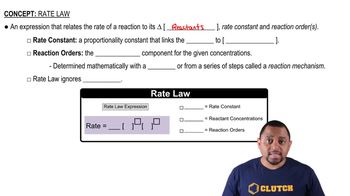
Rate Law

The rate law expresses the relationship between the rate of a chemical reaction and the concentration of its reactants. In this case, the rate law for the decomposition of HI indicates that the rate is proportional to the concentration of HI raised to the fourth power. Understanding the rate law is essential for calculating how concentration changes over time in a reaction.
Video consigliato:
Percorso guidato
01:52
Rate Law Fundamentals

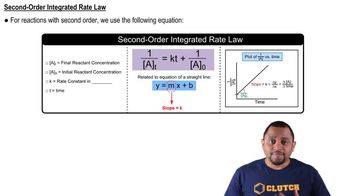
Integrated Rate Law for Second-Order Reactions

For a second-order reaction, the integrated rate law can be used to relate the concentration of reactants to time. The formula is 1/[A] = 1/[A0] + kt, where [A] is the concentration at time t, [A0] is the initial concentration, k is the rate constant, and t is time. This concept is crucial for determining the concentration of HI after a specified time.
Video consigliato:
Percorso guidato
01:59
Second-Order Reactions

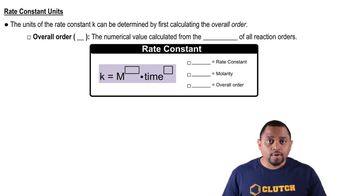
Units of Rate Constant

The units of the rate constant (k) provide insight into the order of the reaction. For a second-order reaction, the units are typically M^-1 min^-1, indicating that the rate depends on the concentration squared. Understanding these units helps in correctly applying the rate law and ensuring that calculations yield valid results.
Video consigliato:
Percorso guidato
00:45
Rate Constant Units
Pratica correlata
Domanda del libro di testo
Use the following equation and graph to answer questions 1 and 2. Hydrogen iodide decomposes at 410 °C, according the reaction: 2 HI1g2¡H21g2 + I21g2 The graph shows how the concentration of HI changes over time. What is the average rate of loss of HI over the time period 0–40 s (LO 14.1) (a) 7.5 * 10-3 M>s (b) 4.8 * 10-3 M>s (c) 3.0 * 10-2 M>s (d) 3.5 * 10-3 M>s
680
views
Domanda del libro di testo
A key reaction in the upper atmosphere is O31g2 + O1g2 ¡ 2 O21g2 For this process, the energy of activation for the forward reaction, Ea1fwd2, is 19 kJ/mol, and the enthalpy change for the reaction, ΔHrxn, is -392 kJ>mol. What is the energy of activation for the reverse reaction, Ea1reverse2? (LO 14.10) (a) 411 kJ/mol (b) 392 kJ/mol (c) 373 kJ/mol (d) 196 kJ/mol
528
views
Domanda del libro di testo
Chlorine monoxide (ClO) decomposes at room temperature according to the reaction 2 ClO1g2¡Cl21g2 + O21g2 The concentration of ClO was monitored over time, and three graphs were made:

What is the rate law for the reaction? (LO 14.9) (a) Rate = k (b) Rate = k3ClO4 (c) Rate = k3ClO42 (d) Rate = k3ClO43 M14_MCMU6230_
384
views
Domanda del libro di testo
To answer questions 13–15, refer to the mechanism: H2O21aq2 + I-1aq2¡OH-1aq2 + HOI1aq2 Slower, rate-determining HOI1aq2 + I-1aq2¡OH-1aq2 + I21aq2 Faster 2 OH-1aq2 + 2 H3O+1aq2¡4 H2O1l2 Faster Identify the catalyst and intermediate(s) in the mechanism. (LO 14.12, 14.16) (a) Catalyst = I-, intermediates = OH-, HOI (b) Catalyst = H3O+, intermediate = HOI (c) No catalyst, intermediate = I2 (d) No catalyst, intermediates = OH-, HOI
456
views
1
rank