A typical aspirin tablet contains 324 mg of aspirin (acetylsalicylic
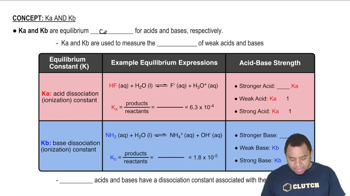
acid, C9H8O4), a monoprotic acid having Ka = 3.0 * 10-4.
If you dissolve two aspirin tablets in a 300 mL glass of water,
what is the pH of the solution and the percent dissociation?
Guida verificata passo dopo passo
1
Calculate the total mass of aspirin in two tablets: 2 * 324 mg.
Convert the mass of aspirin to grams and then to moles using the molar mass of acetylsalicylic acid (C9H8O4).
Determine the concentration of aspirin in the solution by dividing the number of moles by the volume of the solution in liters (300 mL).
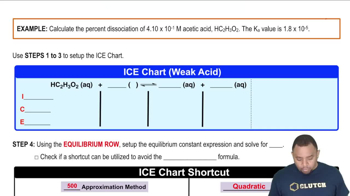
Set up the expression for the dissociation of acetylsalicylic acid (HA) in water and use the given Ka value to write the equilibrium expression: Ka = [H+][A-]/[HA].
Solve for the concentration of H+ ions ([H+]) using the quadratic formula or approximation method, then calculate the pH of the solution using the formula pH = -log[H+].
Risposta video verificata per un problema simile:
Questa soluzione video è stata consigliata dai nostri tutor come utile per risolvere questo problema.
Durata del video:
9m
Guarda un video:
0 Commenti
Concetti chiave
Ecco i concetti essenziali che devi comprendere per rispondere correttamente alla domanda.
Monoprotic Acids
A monoprotic acid is an acid that can donate only one proton (H+) per molecule during dissociation. In the case of acetylsalicylic acid (aspirin), it has one acidic hydrogen that can dissociate in solution, contributing to the acidity of the solution. Understanding the behavior of monoprotic acids is essential for calculating pH and percent dissociation.
The acid dissociation constant (Ka) quantifies the strength of an acid in solution. It is defined as the equilibrium constant for the dissociation of the acid into its conjugate base and a proton. For aspirin, with a Ka of 3.0 x 10^-4, this value indicates that it is a weak acid, and it helps in calculating the concentration of hydrogen ions in solution, which is crucial for determining pH.
Percent dissociation is a measure of the extent to which an acid dissociates in solution, expressed as a percentage of the initial concentration that has dissociated into ions. It is calculated using the formula: (amount dissociated / initial concentration) x 100%. This concept is important for understanding the strength of the acid and its effect on the pH of the solution when aspirin is dissolved in water.



 Guida verificata passo dopo passo
 01:03
01:03