Ch.16 - Aqueous Equilibria: Acids & Bases
McMurry - Chemistry 8th Edition
McMurry8th EditionChemistryISBN: 9781292336145Non è quello che usi tu?Cambia libro di testo
Capitolo 16, Problema 44c

The following picture represents the hydrated metal cation M1H2O26 n + , where n = 1, 2, or 3. (c) Which M1H2O26n + ion 1n = 1,2, or 32 is the strongest acid, and which has the strongest conjugate base?

Guida verificata passo dopo passo
1
insert step 1: Understand the concept of acidity in metal cations. The acidity of a hydrated metal cation is influenced by the charge density of the metal ion. Higher charge and smaller size lead to stronger acidity.
insert step 2: Analyze the given metal cation M(H2O)6^n+. The charge n can be 1, 2, or 3. Consider how the charge affects the acidity.
insert step 3: Compare the acidity of M(H2O)6^1+, M(H2O)6^2+, and M(H2O)6^3+. The higher the charge, the more acidic the cation, because it can polarize the water molecules more effectively, leading to easier release of H+ ions.
insert step 4: Determine which ion has the strongest conjugate base. The strongest acid will have the weakest conjugate base, and vice versa.
insert step 5: Conclude that M(H2O)6^3+ is the strongest acid due to its highest charge, and M(H2O)6^1+ has the strongest conjugate base as it is the weakest acid.

Risposta video verificata per un problema simile:

Questa soluzione video è stata consigliata dai nostri tutor come utile per risolvere questo problema.
Durata del video:
1m

Concetti chiave

Ecco i concetti essenziali che devi comprendere per rispondere correttamente alla domanda.

Hydrated Metal Cations

Hydrated metal cations are metal ions surrounded by water molecules, which stabilize the ion in solution. The number of water molecules coordinated to the metal ion can influence its properties, including acidity. The charge and size of the metal ion, as well as the number of water molecules, play a crucial role in determining the strength of the resulting acid.
Video consigliato:
Percorso guidato
02:04
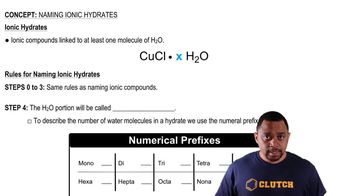
Ionic Hydrates Naming

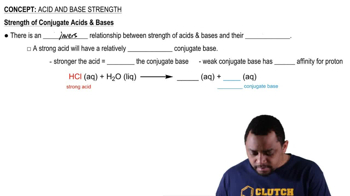
Acid Strength and Conjugate Bases

The strength of an acid is determined by its ability to donate protons (H+ ions) in solution. Stronger acids have weaker conjugate bases, meaning that when they lose a proton, the remaining species is less likely to re-accept a proton. Understanding the relationship between acid strength and the stability of the conjugate base is essential for predicting the behavior of the hydrated metal cations.
Video consigliato:
Percorso guidato
00:50
Strength of Conjugate Acids and Bases

Charge and Coordination Number

The charge of a metal cation and its coordination number (the number of water molecules attached) significantly affect its acidity. Higher charged cations tend to be stronger acids because they can stabilize the negative charge of the conjugate base more effectively. Additionally, the coordination number influences the geometry and electronic environment around the metal ion, further impacting its acid-base properties.
Video consigliato:
Percorso guidato
00:27
Coordination Numbers