

Ch.17 - Applications of Aqueous Equilibria
McMurry - Chemistry 8th Edition
McMurry8th EditionChemistryISBN: 9781292336145Non è quello che usi tu?Cambia libro di testo
Capitolo 17, Problema 149

A 1.000 L sample of HCl gas at 25°C and 732.0 mm Hg was absorbed completely in an aqueous solution that contained 6.954 g of Na2CO3 and 250.0 g of water. (a) What is the pH of the solution?

Guida verificata passo dopo passo
1
Step 1: First, we need to calculate the number of moles of HCl gas. We can use the ideal gas law equation, PV = nRT, where P is the pressure, V is the volume, n is the number of moles, R is the ideal gas constant, and T is the temperature in Kelvin. Convert the pressure from mm Hg to atm and the temperature from Celsius to Kelvin before substituting the values into the equation.
Step 2: Next, we need to calculate the number of moles of Na2CO3. We can do this by using the molar mass of Na2CO3, which is approximately 105.99 g/mol. Divide the mass of Na2CO3 by its molar mass to get the number of moles.
Step 3: Now, we need to write the balanced chemical equation for the reaction between HCl and Na2CO3. The equation is: 2HCl + Na2CO3 -> 2NaCl + H2O + CO2. From the balanced equation, we can see that 2 moles of HCl react with 1 mole of Na2CO3.
Step 4: Determine the limiting reactant. If the number of moles of HCl is more than twice the number of moles of Na2CO3, then Na2CO3 is the limiting reactant. If not, HCl is the limiting reactant. The limiting reactant will determine the amount of HCl that remains unreacted and contributes to the acidity of the solution.
Step 5: Finally, calculate the pH of the solution. If HCl is the limiting reactant, all of it will react and the solution will be neutral, with a pH of 7. If Na2CO3 is the limiting reactant, some HCl will remain unreacted. The concentration of HCl can be calculated by dividing the remaining moles of HCl by the total volume of the solution. The pH can then be calculated using the formula pH = -log[H+], where [H+] is the concentration of H+ ions, which is equal to the concentration of HCl in the solution.

Risposta video verificata per un problema simile:

Questa soluzione video è stata consigliata dai nostri tutor come utile per risolvere questo problema.
Durata del video:
13m

Concetti chiave

Ecco i concetti essenziali che devi comprendere per rispondere correttamente alla domanda.

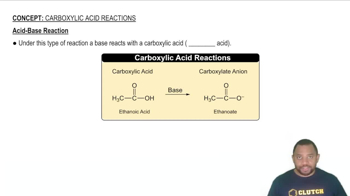
Acid-Base Reactions

Acid-base reactions involve the transfer of protons (H+) between reactants. In this case, HCl, a strong acid, will dissociate completely in water, releasing H+ ions. The reaction with Na2CO3, a weak base, will produce bicarbonate ions and affect the pH of the solution, making it essential to understand how these species interact.
Video consigliato:
Percorso guidato
01:09
Acid-Base Reaction

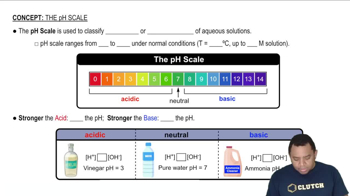
pH Scale

The pH scale measures the acidity or basicity of a solution, ranging from 0 (very acidic) to 14 (very basic), with 7 being neutral. The pH is calculated as the negative logarithm of the hydrogen ion concentration. Understanding how to calculate pH from the concentration of H+ ions is crucial for determining the acidity of the resulting solution after the reaction.
Video consigliato:

Stoichiometry

Stoichiometry involves the calculation of reactants and products in chemical reactions based on balanced equations. In this scenario, determining the amount of HCl that reacts with Na2CO3 requires stoichiometric relationships to find the moles of each substance involved, which is necessary for calculating the resulting pH of the solution.
Video consigliato:
Percorso guidato
01:16
Stoichiometry Concept
Pratica correlata
Domanda del libro di testo

In qualitative analysis, Ca2+ and Ba2+ are seperated from Na+, K+, Mg2+ by adding aqueous (NH4)2CO3 to a solution that also contains aqueous NH3 (Figure 17.18). Assume that the concentrations after mixing are 0.080 M (NH4)2CO3 and 0.16 M NH3. (a) List all the Bronsted-Lowry acids and bases present initially, and identify the principal reaction.

526
views
Domanda del libro di testo

A 40.0 mL sample of a mixture of HCl and H3PO4 was titrated with 0.100 M NaOH. The first equivalence point was reached after 88.0 mL of base, and the second equivalence point was reached after 126.4 mL of base. (f) What indicators would you select to signal the equivalence points?

565
views
Domanda del libro di testo
A saturated solution of an ionic salt MX exhibits an osmotic pressure of 74.4 mm Hg at 25 °C. Assuming that MX is completely dissociated in solution, what is the value of its Ksp?
484
views
Domanda del libro di testo

A 40.0 mL sample of a mixture of HCl and H3PO4 was titrated with 0.100 M NaOH. The first equivalence point was reached after 88.0 mL of base, and the second equivalence point was reached after 126.4 mL of base. (c) What percent of the HCl is neutralized at the first equivalence point?

589
views
Domanda del libro di testo

A 40.0 mL sample of a mixture of HCl and H3PO4 was titrated with 0.100 M NaOH. The first equivalence point was reached after 88.0 mL of base, and the second equivalence point was reached after 126.4 mL of base. (b) What are the initial concentrations of HCl and H3PO4 in the mixture?

730
views