Ch.18 - Thermodynamics: Entropy, Free Energy & Equilibrium
McMurry - Chemistry 8th Edition
McMurry8th EditionChemistryISBN: 9781292336145Non è quello che usi tu?Cambia libro di testo
Capitolo 18, Problema 136

A mixture of 14.0 g of N2 and 3.024 g of H2 in a 5.00 L container is heated to 400 °C. Use the data in Appendix B to calculate the molar concentrations of N2, H2, and NH3 at equilibrium. Assume that ∆H° and ∆S° are independent of temperature, and remember that the standard state of a gas is defined in terms of pressure. Thermodynamic data for N2O4 and NO2, including enthalpy and entropy values.

Guida verificata passo dopo passo
1
Step 1: Write the balanced chemical equation for the reaction: N2(g) + 3H2(g) ⇌ 2NH3(g).
Step 2: Calculate the initial moles of N2 and H2 using their given masses and molar masses (N2: 28.02 g/mol, H2: 2.02 g/mol).
Step 3: Set up an ICE (Initial, Change, Equilibrium) table to determine the changes in moles of N2, H2, and NH3 as the reaction reaches equilibrium.
Step 4: Use the equilibrium constant expression for the reaction, Kc = [NH3]^2 / ([N2][H2]^3), and the given temperature to find the equilibrium concentrations.
Step 5: Solve the equilibrium constant expression for the equilibrium concentrations of N2, H2, and NH3, using the changes in moles from the ICE table and the volume of the container (5.00 L).

Risposta video verificata per un problema simile:

Questa soluzione video è stata consigliata dai nostri tutor come utile per risolvere questo problema.
Durata del video:
11m

Concetti chiave

Ecco i concetti essenziali che devi comprendere per rispondere correttamente alla domanda.

Molar Concentration

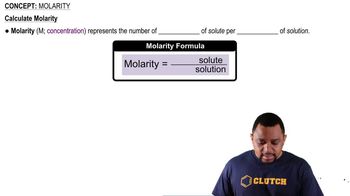
Molar concentration, or molarity, is defined as the number of moles of solute per liter of solution. It is a crucial concept in chemistry for quantifying the concentration of reactants and products in a reaction. In this question, calculating the molar concentrations of N2, H2, and NH3 at equilibrium requires determining the number of moles of each gas and dividing by the volume of the container.
Video consigliato:
Percorso guidato
00:53
Molarity Concept

Equilibrium Constant (K)

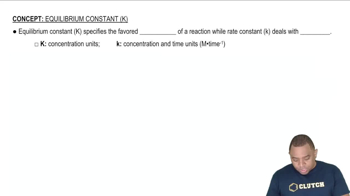
The equilibrium constant (K) is a value that expresses the ratio of the concentrations of products to reactants at equilibrium for a reversible reaction. It is influenced by temperature and can be calculated using the concentrations of the gases involved. Understanding how to derive K from the reaction and apply it to find the equilibrium concentrations of N2, H2, and NH3 is essential for solving the problem.
Video consigliato:
Percorso guidato
01:14
Equilibrium Constant K

Thermodynamic Data (ΔH° and S°)

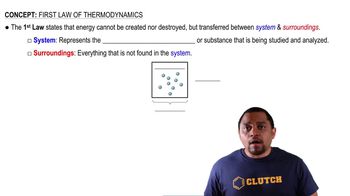
Thermodynamic data, including standard enthalpy change (ΔH°) and standard entropy (S°), provide essential information about the energy changes and disorder associated with chemical reactions. These values are used to calculate the Gibbs free energy change (ΔG°), which helps predict the spontaneity of the reaction and the position of equilibrium. In this question, the provided thermodynamic data for N2O4 and NO2 will be necessary for determining the equilibrium state of the reaction.
Video consigliato:
Percorso guidato
01:18
First Law of Thermodynamics