Ch.18 - Thermodynamics: Entropy, Free Energy & Equilibrium
McMurry - Chemistry 8th Edition
McMurry8th EditionChemistryISBN: 9781292336145Non è quello che usi tu?Cambia libro di testo
Capitolo 18, Problema 124d

Consider the Haber synthesis of gaseous NH3 (∆H°f = -46.1 kJ/mol; ∆G°f = -16.5 kJ/mol: (d) What are the equilibrium constants Kp and Kc for the reaction at 350 K? Assume that ∆H° and ∆S° are independent of temperature.

Guida verificata passo dopo passo
1
First, write down the balanced chemical equation for the Haber process: N2(g) + 3 H2(g) ⇌ 2 NH3(g).
Use the given standard Gibbs free energy of formation (∆G°f) to calculate the standard Gibbs free energy change for the reaction (∆G°rxn) using the formula: ∆G°rxn = ∑∆G°f(products) - ∑∆G°f(reactants).
Calculate the equilibrium constant K at 350 K using the relationship between Gibbs free energy and the equilibrium constant, K = e(-∆G°rxn / RT), where R is the gas constant (8.314 J/mol·K) and T is the temperature in Kelvin.
To find Kp, use the equation Kp = Kc(RT)Δn, where Δn is the change in moles of gas (moles of gaseous products minus moles of gaseous reactants) for the reaction.
To find Kc, use the relationship Kc = Kp / (RT)Δn. Calculate Kc using the value of Kp obtained in the previous step and the same values for R and T.

Risposta video verificata per un problema simile:

Questa soluzione video è stata consigliata dai nostri tutor come utile per risolvere questo problema.
Durata del video:
6m

Concetti chiave

Ecco i concetti essenziali che devi comprendere per rispondere correttamente alla domanda.

Haber Synthesis

The Haber synthesis is a chemical reaction that combines nitrogen gas (N₂) and hydrogen gas (H₂) to produce ammonia (NH₃). This process is crucial for producing fertilizers and is represented by the equation N₂(g) + 3H₂(g) ⇌ 2NH₃(g). Understanding this reaction involves recognizing its enthalpy change (∆H°) and Gibbs free energy change (∆G°), which indicate the energy dynamics and spontaneity of the reaction.
Video consigliato:
Percorso guidato
03:49
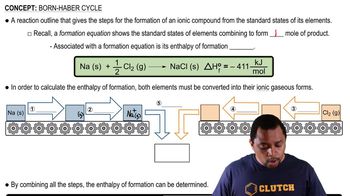
Born Haber Cycle

Equilibrium Constants (Kp and Kc)

Equilibrium constants, Kp and Kc, quantify the ratio of products to reactants at equilibrium for a given reaction. Kp is used for gas-phase reactions and is expressed in terms of partial pressures, while Kc is used for reactions in solution and is expressed in terms of molar concentrations. The relationship between Kp and Kc can be derived from the ideal gas law and the reaction's stoichiometry, and they are temperature-dependent.
Video consigliato:
Percorso guidato
02:06
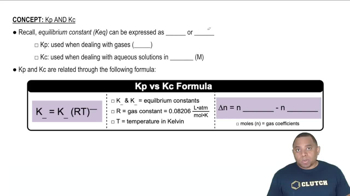
Kp vs. Kc Formula

Gibbs Free Energy and Temperature

Gibbs free energy (G) is a thermodynamic potential that helps predict the direction of chemical reactions. The change in Gibbs free energy (∆G) at a given temperature indicates whether a reaction is spontaneous (∆G < 0) or non-spontaneous (∆G > 0). The relationship between Gibbs free energy and equilibrium constants is given by the equation ∆G° = -RT ln(K), where R is the gas constant and T is the temperature in Kelvin, allowing for the calculation of Kp and Kc at specific temperatures.
Video consigliato:
Percorso guidato
00:32
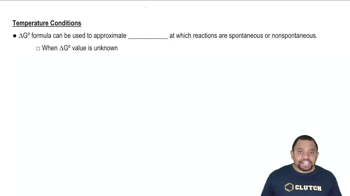
Standard Gibbs Free Energy and Temperature