

Ch.18 - Thermodynamics: Entropy, Free Energy & Equilibrium
McMurry - Chemistry 8th Edition
McMurry8th EditionChemistryISBN: 9781292336145Non è quello che usi tu?Cambia libro di testo
Capitolo 18, Problema 71

What are the values of x and y for the following reaction if E° = 0.91 V and ∆G° = -527 kJ?

Guida verificata passo dopo passo
1
Identify the relationship between Gibbs free energy change (\( \Delta G^\circ \)) and the standard cell potential (\( E^\circ \)) using the equation: \( \Delta G^\circ = -nFE^\circ \), where \( n \) is the number of moles of electrons transferred and \( F \) is the Faraday constant (approximately 96485 C/mol).
Rearrange the equation to solve for \( n \): \( n = \frac{-\Delta G^\circ}{FE^\circ} \).
Substitute the given values into the equation: \( \Delta G^\circ = -527 \text{ kJ} = -527000 \text{ J} \) and \( E^\circ = 0.91 \text{ V} \).
Calculate \( n \) using the rearranged equation: \( n = \frac{-(-527000 \text{ J})}{96485 \text{ C/mol} \times 0.91 \text{ V}} \).
Interpret the value of \( n \) to determine the stoichiometric coefficients \( x \) and \( y \) in the balanced redox reaction, ensuring that the number of electrons transferred corresponds to the calculated \( n \).

Risposta video verificata per un problema simile:

Questa soluzione video è stata consigliata dai nostri tutor come utile per risolvere questo problema.
Durata del video:
1m

Concetti chiave

Ecco i concetti essenziali che devi comprendere per rispondere correttamente alla domanda.

Standard Electrode Potential (E°)

The standard electrode potential (E°) is a measure of the tendency of a chemical species to be reduced, expressed in volts. It is determined under standard conditions (1 M concentration, 1 atm pressure, and 25°C). A positive E° indicates a greater likelihood of reduction, while a negative E° suggests a tendency to oxidize. In this question, E° = 0.91 V indicates a favorable reaction direction.
Video consigliato:
Percorso guidato
01:27
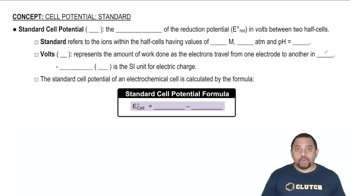
Standard Cell Potential

Gibbs Free Energy (∆G°)

Gibbs free energy (∆G°) is a thermodynamic potential that measures the maximum reversible work obtainable from a thermodynamic system at constant temperature and pressure. A negative ∆G° value, such as -527 kJ, indicates that the reaction is spontaneous under standard conditions. The relationship between ∆G° and E° is given by the equation ∆G° = -nFE°, where n is the number of moles of electrons transferred and F is Faraday's constant.
Video consigliato:
Percorso guidato
01:51
Gibbs Free Energy of Reactions

Stoichiometry of Redox Reactions

Stoichiometry in redox reactions involves balancing the number of electrons transferred between oxidizing and reducing agents. The values of x and y in the reaction typically represent the coefficients of the reactants and products in the balanced equation. Understanding the stoichiometry is essential for determining how many moles of each species are involved, which directly relates to the values of n in the Gibbs free energy equation and the overall reaction balance.
Video consigliato:
Percorso guidato
03:12
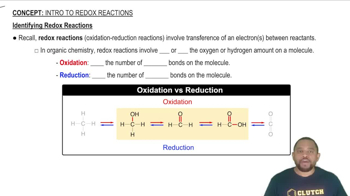
Identifying Redox Reactions