Classify each of the following unbalanced half-reactions as either an oxidation or a reduction. (b) Pt2+ (aq) → Pt(s)
Ch.19 - Electrochemistry
Capitolo 19, Problema 40c
Porous pellets of TiO2 can be reduced to titanium metal at the cathode of an electrochemical cell containing molten CaCl2 as the electrolyte. When the TiO2 is reduced, the O2-ions dis-solve in the CaCl2 and are subsequently oxidized to O2 gas at the anode. This approach may be the basis for a less expensive process than the one currently used for producing titanium.
(c) Write balanced equations for the anode, cathode, and overall cell reactions.
Guida verificata passo dopo passo1
insert step 1> Identify the half-reactions occurring at the cathode and anode. At the cathode, TiO_2 is reduced to titanium metal, and at the anode, O^{2-} ions are oxidized to O_2 gas.
insert step 2> Write the reduction half-reaction at the cathode. TiO_2 is reduced to Ti metal, so the half-reaction is: TiO_2 + 4e^- + 4H^+ \(\rightarrow\) Ti + 2H_2O.
insert step 3> Write the oxidation half-reaction at the anode. O^{2-} ions are oxidized to O_2 gas, so the half-reaction is: 2O^{2-} \(\rightarrow\) O_2 + 4e^-.
insert step 4> Balance the electrons in both half-reactions to ensure the number of electrons lost in the oxidation reaction equals the number gained in the reduction reaction.
insert step 5> Combine the balanced half-reactions to write the overall balanced cell reaction.

Risposta video verificata per un problema simile:
Questa soluzione video è stata consigliata dai nostri tutor come utile per risolvere questo problema.
Durata del video:
2mConcetti chiave
Ecco i concetti essenziali che devi comprendere per rispondere correttamente alla domanda.
Electrochemical Cells
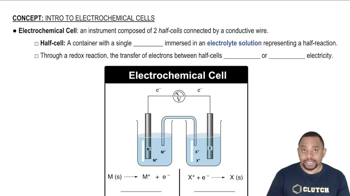
Electrochemical cells are devices that convert chemical energy into electrical energy through redox reactions. They consist of two electrodes: the anode, where oxidation occurs, and the cathode, where reduction takes place. Understanding the flow of electrons and the movement of ions in these cells is crucial for writing balanced equations for the reactions involved.
Video consigliato:
Percorso guidato
Electrochemical Cells
Oxidation and Reduction
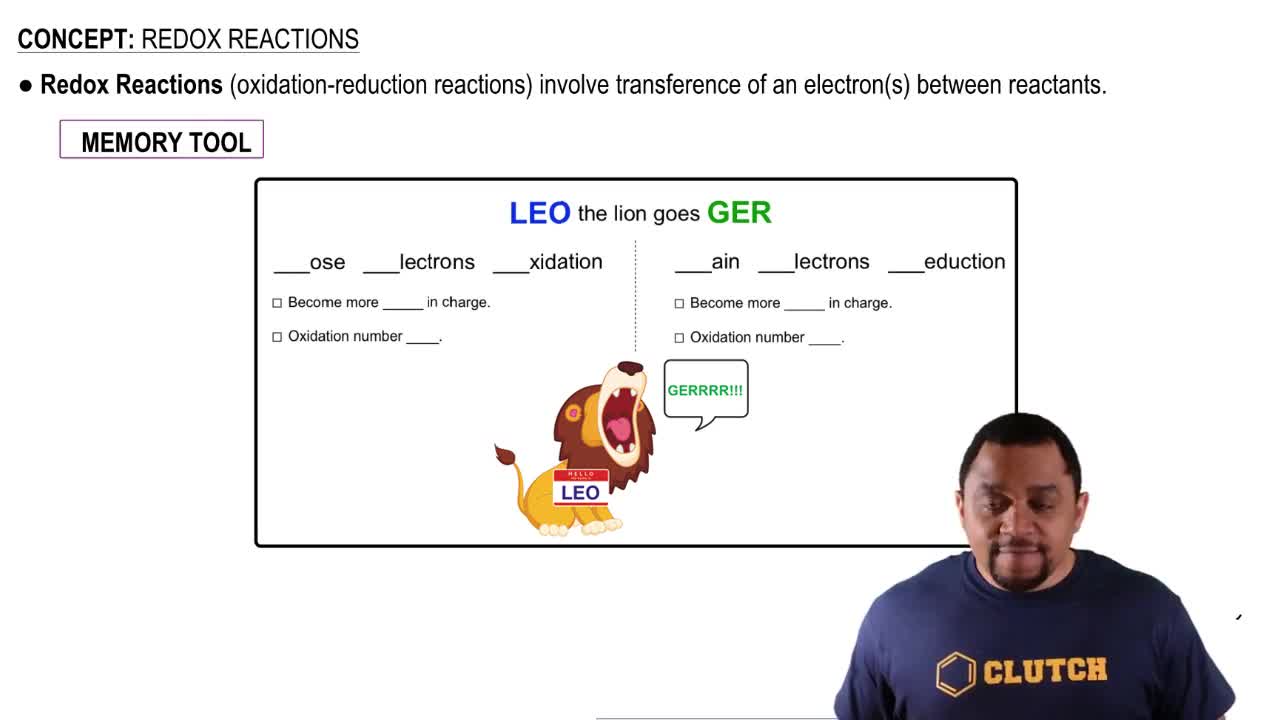
Oxidation and reduction are fundamental concepts in chemistry that describe the transfer of electrons between species. Oxidation involves the loss of electrons, while reduction involves the gain of electrons. In the context of the electrochemical cell described, the TiO2 is reduced at the cathode, and the O2- ions are oxidized at the anode, which is essential for balancing the overall cell reaction.
Video consigliato:
Percorso guidato
Oxidation and Reduction Reactions
Balancing Redox Reactions
Balancing redox reactions requires ensuring that the number of electrons lost in oxidation equals the number gained in reduction. This involves identifying the oxidation states of the elements involved and adjusting coefficients in the half-reactions to achieve mass and charge balance. Mastery of this concept is necessary to write accurate balanced equations for the anode, cathode, and overall reactions in the electrochemical cell.
Video consigliato:
Percorso guidato
Balancing Basic Redox Reactions
Pratica correlata
Domanda del libro di testo
430
views
Domanda del libro di testo
Sketch a cell with inert electrodes suitable for electrolysis of aqueous CuBr2.
(b) Indicate the direction of electron and ion flow.
659
views
Domanda del libro di testo
Consider a Daniell cell with 1.0 M ion concentrations: Does the cell voltage increase, decrease, or remain the same when each of the following changes is made? Explain.
(a) Write a balanced equation for each cell reaction.
1009
views
Domanda del libro di testo
Classify each of the following unbalanced half-reactions as either an oxidation or a reduction. (a) O2(g) → OH-(aq)
511
views
Domanda del libro di testo
Classify each of the following unbalanced half-reactions as either an oxidation or a reduction. (c) Cr(s) → Cr3+ (aq)
627
views
Domanda del libro di testo
Porous pellets of TiO2 can be reduced to titanium metal at the cathode of an electrochemical cell containing molten CaCl2 as the electrolyte. When the TiO2 is reduced, the O2-ions dis-solve in the CaCl2 and are subsequently oxidized to O2 gas at the anode. This approach may be the basis for a less expensive process than the one currently used for producing titanium.
(a) Label the anode and cathode, and indicate the signs of the electrodes.
365
views