Ch.19 - Electrochemistry
McMurry - Chemistry 8th Edition
McMurry8th EditionChemistryISBN: 9781292336145Non è quello che usi tu?Cambia libro di testo
Capitolo 19, Problema 14

What are the products of the overall reaction in the elec-trolysis of an aqueous solution of sodium hydroxide? (Refer to Table 19.1 for standard reduction potentials.) (a) Na(s) and O2(g) (b) H2(g) and O2(g) (c) Na(s) and H2(g) (d) Na(s) and H2O2(aq)

Guida verificata passo dopo passo
1
Identify the components present in the aqueous solution of sodium hydroxide (NaOH), which are Na^+, OH^-, and H2O.
Consider the possible half-reactions at the anode (oxidation) and cathode (reduction) using standard reduction potentials.
At the cathode, reduction can occur. The possible reduction reactions are Na^+ + e^- -> Na(s) and 2H2O + 2e^- -> H2(g) + 2OH^-. Compare their standard reduction potentials to determine which is more favorable.
At the anode, oxidation can occur. The possible oxidation reactions are 4OH^- -> O2(g) + 2H2O + 4e^- and 2H2O -> O2(g) + 4H^+ + 4e^-. Compare their standard oxidation potentials to determine which is more favorable.
Combine the favorable half-reactions from the cathode and anode to determine the overall reaction and identify the products.

Risposta video verificata per un problema simile:

Questa soluzione video è stata consigliata dai nostri tutor come utile per risolvere questo problema.
Durata del video:
4m

Concetti chiave

Ecco i concetti essenziali che devi comprendere per rispondere correttamente alla domanda.

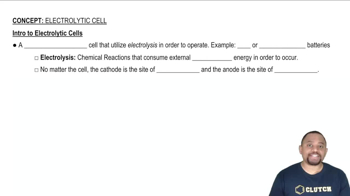
Electrolysis

Electrolysis is a chemical process that uses electrical energy to drive a non-spontaneous reaction. In an electrolytic cell, an electric current is passed through an electrolyte, causing the decomposition of the compound. In the case of sodium hydroxide (NaOH), the electrolysis leads to the production of hydrogen gas at the cathode and oxygen gas at the anode.
Video consigliato:
Percorso guidato
01:21
The Electrolytic Cell

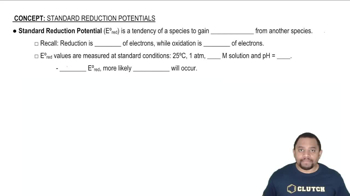
Standard Reduction Potentials

Standard reduction potentials are a measure of the tendency of a chemical species to gain electrons and be reduced. These values, typically found in tables, allow chemists to predict the direction of redox reactions. In the context of electrolysis, comparing the standard reduction potentials of the relevant half-reactions helps determine which species will be reduced and oxidized during the process.
Video consigliato:
Percorso guidato
01:10
Standard Reduction Potentials

Half-Reactions in Electrolysis

In electrolysis, the overall reaction can be broken down into two half-reactions: one for oxidation and one for reduction. For an aqueous solution of sodium hydroxide, the reduction half-reaction typically involves the formation of hydrogen gas, while the oxidation half-reaction involves the production of oxygen gas. Understanding these half-reactions is crucial for identifying the products of the electrolysis process.
Video consigliato:
Percorso guidato
01:49
First-Order Half-Life