Predict the crystal field energy-level diagram for a linear ML2 complex that has two ligands along the :
Ch.21 - Transition Elements and Coordination Chemistry
Tutti i libri di testo
McMurry 8th Edition
Ch.21 - Transition Elements and Coordination Chemistry
Problema 21.39
McMurry 8th Edition
Ch.21 - Transition Elements and Coordination Chemistry
Problema 21.39Capitolo 21, Problema 21.39
Predict the number of unpaired electrons for each of the following.
(a) Sc3+
(b) Co2+
Guida verificata passo dopo passo1
Determine the electron configuration of the neutral atom for each element.
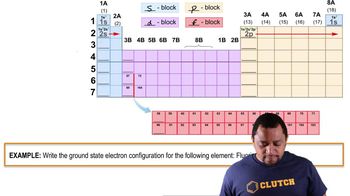
For Scandium (Sc), the atomic number is 21, so the electron configuration is [Ar] 3d^1 4s^2.
For Cobalt (Co), the atomic number is 27, so the electron configuration is [Ar] 3d^7 4s^2.
Remove electrons according to the charge of the ion. For Sc^3+, remove three electrons from the outermost orbitals, resulting in [Ar].
For Co^2+, remove two electrons from the outermost orbitals, resulting in [Ar] 3d^7. Determine the number of unpaired electrons in the 3d subshell.

Risposta video verificata per un problema simile:
Questa soluzione video è stata consigliata dai nostri tutor come utile per risolvere questo problema.
Concetti chiave
Ecco i concetti essenziali che devi comprendere per rispondere correttamente alla domanda.
Electron Configuration
Electron configuration describes the distribution of electrons in an atom's orbitals. It follows the Aufbau principle, which states that electrons fill lower-energy orbitals first. Understanding the electron configuration of an element is crucial for predicting its chemical behavior, including the number of unpaired electrons.
Video consigliato:
Percorso guidato
Electron Configuration Example
Unpaired Electrons
Unpaired electrons are those that occupy an orbital alone, without a partner of opposite spin. The presence of unpaired electrons in an atom influences its magnetic properties and reactivity. Atoms with unpaired electrons are often paramagnetic, while those with all electrons paired are diamagnetic.
Video consigliato:
Percorso guidato
Electron Geometry
Transition Metals and Oxidation States
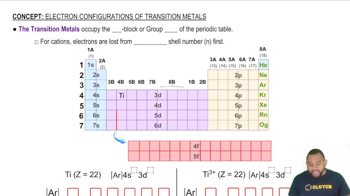
Transition metals can exhibit multiple oxidation states due to their ability to lose different numbers of d electrons. The oxidation state affects the electron configuration and, consequently, the number of unpaired electrons. For example, Scandium (Sc) in the +3 oxidation state loses three electrons, while Cobalt (Co) in the +2 state loses two, altering their electron configurations.
Video consigliato:
Percorso guidato
Transition Metals
Pratica correlata
Domanda del libro di testo
108
views
Domanda del libro di testo
Draw the structures of all possible diastereoisomers of an octahedral complex with the formula MA2B2C2. Which of the diastereoisomers, if any, can exist as enantiomers?
95
views
Domanda del libro di testo
Look at the colors of the isomeric complexes in Figure 21.12, and predict which is the stronger field ligand, nitro (-NO2) of nitrito (-ONO). Explain.
90
views
Domanda del libro di testo
Draw the structure of all isomers of the octahedral complex [NbX2Cl4]- (X- = NCS-), and identify those that are linkage isomers.
99
views
Domanda del libro di testo
What is the systematic name for each of the following coordination compounds?
(c) [Co(NH3)4Br2]Br
(d) Cu(gly)2
170
views
Domanda del libro di testo
Classify the following ligands as monodentate, bidentate, tri-dentate, or tetradentate. Which can form chelate rings?
(a)
(b)
(c)
(d)
108
views