
Ch.21 - Transition Elements and Coordination Chemistry
McMurry - Chemistry 8th Edition
McMurry8th EditionChemistryISBN: 9781292336145Non è quello che usi tu?Cambia libro di testo
Capitolo 21, Problema 21.105

The [Cr(H2O)6]3+ ion is violet, and [Cr(CN)6]3- is yellow. Explain this difference using crystal field theory. Use the colors to order H2O and CN- in the spectrochemical series.

Guida verificata passo dopo passo
1
Step 1: Understand that the color of a complex ion is due to the absorption of light which promotes an electron from a lower energy d-orbital to a higher energy d-orbital. The color we see is the complementary color of the light absorbed.
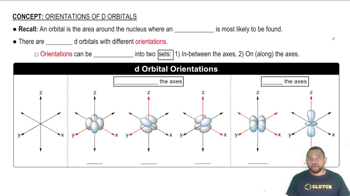
Step 2: Recognize that the crystal field theory explains the color of transition metal complexes in terms of the splitting of their d-orbitals into two sets of different energies when ligands approach the metal ion. The difference in energy between these two sets of d-orbitals corresponds to the energy of light absorbed.
Step 3: Realize that the extent of splitting of the d-orbitals, and hence the color of the complex, depends on the nature of the ligands. Ligands that cause a large splitting of the d-orbitals are known as strong-field ligands, while those that cause a small splitting are known as weak-field ligands.
Step 4: Infer from the given colors that [Cr(H2O)6]3+ absorbs light of higher energy (shorter wavelength) than [Cr(CN)6]3-. This is because violet light is the complementary color of yellow light, which is of lower energy (longer wavelength). Therefore, H2O is a weaker field ligand than CN-.
Step 5: Conclude that in the spectrochemical series, which orders ligands according to their ability to split the d-orbitals, H2O comes before CN-.

Risposta video verificata per un problema simile:

Questa soluzione video è stata consigliata dai nostri tutor come utile per risolvere questo problema.

Concetti chiave

Ecco i concetti essenziali che devi comprendere per rispondere correttamente alla domanda.

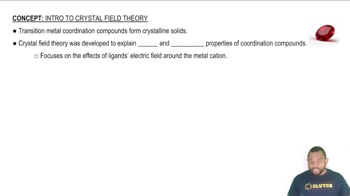
Crystal Field Theory

Crystal Field Theory (CFT) explains the electronic structure of transition metal complexes by considering the effect of surrounding ligands on the d-orbitals of the metal ion. When ligands approach the metal ion, they create an electric field that splits the degenerate d-orbitals into different energy levels. The extent of this splitting depends on the nature of the ligands and their arrangement around the metal ion.
Video consigliato:
Percorso guidato
01:18
The study of ligand-metal interactions helped to form Ligand Field Theory which combines CFT with MO Theory.

Spectrochemical Series

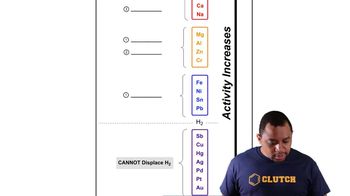
The spectrochemical series is a list that ranks ligands based on the strength of the field they produce when coordinating to a metal ion. Strong field ligands, like CN<sup>-</sup>, cause a larger splitting of the d-orbitals, leading to higher energy transitions and different colors. Conversely, weak field ligands, such as H<sub>2</sub>O, result in smaller splitting and lower energy transitions, which can be observed in the color of the complexes.
Video consigliato:
Percorso guidato
02:02
Activity Series Chart

Color and d-Orbital Splitting

The color observed in transition metal complexes is a result of the specific wavelengths of light absorbed during electronic transitions between split d-orbitals. The energy difference between these orbitals corresponds to specific colors in the visible spectrum. For example, the violet color of [Cr(H<sub>2</sub>O)<sub>6</sub>]<sup>3+</sup> indicates that it absorbs light in the yellow-green region, while the yellow color of [Cr(CN)<sub>6</sub>]<sup>3-</sup> suggests it absorbs light in the violet region, reflecting the differences in ligand field strength.
Video consigliato:
Percorso guidato
02:06
d Orbital Orientations
Pratica correlata
Domanda del libro di testo

Draw the three possible diastereoisomers of the triethylenetetramine complex [Co(trend)Cl2]+. Abbreviate the flexible tetradentate trien ligand H2NCH2CH2NHCH2CH2NHCH2CH2NH2 as . Which of the isomers can exist as a pair of enantiomers?

110
views
Domanda del libro di testo

Draw a crystal field energy-level diagram for the 3d orbitals of titanium in [Ti(H2O)6]3+]. Indicate the crystal field splitting, and explain why is [Ti(H2O)6]3+] colored.

126
views
Domanda del libro di testo

What role does EDTA4- play as a trace additive to mayonnaise? Would the glycinate ion (H2NCH2CH2NH2) be an effective substitute for EDTA4-?

71
views
Domanda del libro di testo

Predict the crystal field energy-level diagram for a square pyramidal ML5 complex that has two ligands along the axes but only one ligand along the z axis. Your diagram should be intermediate between those for an octahedral ML6 complex and a square planar ML4 complex.

109
views
Domanda del libro di testo
In excess of NH3(aq), Zn2+ forms a complex ion, [Zn(NH3)4]2+ which has a formation constant Kf = 7.8 x 10^8. Calculate the concentration of Zn2+ in a solution prepared by adding 1.00 x 10^-2 mol Zn(NO3)2 to 1.00 L of 0.250 M NH3. (a) 7.9 x 10^-4 M (b) 2.8 x 10^-6 M (c) 3.9 x 10^-9 M (d) 6.4 x 10^-11 M
2280
views
Domanda del libro di testo

For each of the following complexes, draw a crystal field energy-level diagram, assign the electrons to orbitals, and predict the number of unpaired electrons. 

(d) [Cu(en)2]2+ (square planar) 

118
views