What is the highest oxidation state for each of the elements from Sc to Zn?
Ch.21 - Transition Elements and Coordination Chemistry
Tutti i libri di testo
McMurry 8th Edition
Ch.21 - Transition Elements and Coordination Chemistry
Problema 21.64
McMurry 8th Edition
Ch.21 - Transition Elements and Coordination Chemistry
Problema 21.64Capitolo 21, Problema 21.64
What is the oxidation state of the metal in each of the complexes?
a. AgCl2–
b. [Cr(H2O)5Cl]2+
c. [Co(NCS)4]2–
d. [ZrF8]4–
e. [Fe(EDTA)(H2O)]–
Guida verificata passo dopo passo1
Step 1: Understand the concept of oxidation state. The oxidation state is the charge of an atom if all bonds were ionic. It helps in determining the electron count of the metal in a complex.
Step 2: For each complex, identify the charge of the ligands and the overall charge of the complex. This will help in determining the oxidation state of the metal.
Step 3: For complex a, AgCl2–: Chloride (Cl–) has a charge of -1. With two chlorides, the total charge from ligands is -2. The overall charge of the complex is -1. Use the equation: oxidation state of Ag + (-2) = -1.
Step 4: For complex b, [Cr(H2O)5Cl]2+: Water (H2O) is neutral, and chloride (Cl–) has a charge of -1. The overall charge of the complex is +2. Use the equation: oxidation state of Cr + (-1) = +2.
Step 5: Repeat similar calculations for the remaining complexes: c. [Co(NCS)4]2–, d. [ZrF8]4–, and e. [Fe(EDTA)(H2O)]–, considering the charges of NCS–, F–, and EDTA4– respectively.

Risposta video verificata per un problema simile:
Questa soluzione video è stata consigliata dai nostri tutor come utile per risolvere questo problema.
Concetti chiave
Ecco i concetti essenziali che devi comprendere per rispondere correttamente alla domanda.
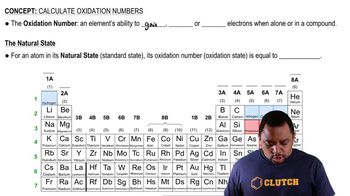
Oxidation State
The oxidation state, or oxidation number, is a measure of the degree of oxidation of an atom in a chemical compound. It indicates the number of electrons that an atom can gain, lose, or share when forming chemical bonds. Understanding oxidation states is crucial for determining the charge of metal ions in coordination complexes and helps in balancing redox reactions.
Video consigliato:
Percorso guidato
Oxidation Numbers
Coordination Complexes
Coordination complexes consist of a central metal atom or ion bonded to surrounding molecules or ions, known as ligands. The nature of these ligands and their arrangement around the metal can influence the oxidation state of the metal. Analyzing the overall charge of the complex and the charges of the ligands is essential for calculating the oxidation state of the metal.
Video consigliato:
Percorso guidato
Coordination Complexes Example
Charge Balance
Charge balance is the principle that the total positive charge in a compound must equal the total negative charge. In coordination complexes, this involves summing the oxidation states of the metal and the charges of the ligands to ensure that the overall charge of the complex matches the given charge. This concept is fundamental for determining the oxidation state of the metal in various complexes.
Video consigliato:
Percorso guidato
Formal Charge
Pratica correlata
Domanda del libro di testo
101
views
Domanda del libro di testo
Although Cl- is a weak-field ligand and CN- is a strong field ligand, [CrCl6]3- and [Cr(CN)6]3- exhibit approximately the same amount of paramagnetism. Explain.
115
views
Domanda del libro di testo
The glycinate anion, gly-= NH2CH2CO2 -, bonds to metal ions through the N atom and one of the O atoms. Using to represent gly-, sketch the structures of the four stereoisomers of Co(gly)3.
134
views
Domanda del libro di testo
What is the oxidation state of the metal in each of the complexes?
a. [Ni(CN)5]3–
b. Ni(CO)4
c. [Co(en)2(H2O)Br]2+
d. [Cu(H2O)2(C2O4)2]2–
e. Co(NH3)3(NO2)3
72
views
Domanda del libro di testo
Draw all possible diastereoisomers of [Cr(C2O4)2(H2O)2]-. Which can exist as a pair of enantiomers?
120
views
Domanda del libro di testo
Which of the following complexes can exist as diastereoisomers?
(a) [Cr(NH3)2Cl4]-
(b) [Co(NH3)5Br]2+
(c) [MnCl2Br2]2- (tetrahedral)
(d) [Pt(NH3)2Br2]2-
89
views