Ch.3 - Mass Relationships in Chemical Reactions
McMurry - Chemistry 8th Edition
McMurry8th EditionChemistryISBN: 9781292336145Non è quello che usi tu?Cambia libro di testo
Capitolo 3, Problema 43a

Balance the following equations. (a) CO(NH2)2(aq) + HOCl(aq) --> NCl3(aq) + CO2(aq) + H2O(l)

Guida verificata passo dopo passo
1
Identify the number of each type of atom on both sides of the equation. For the reactants: C = 1, O = 1, N = 2, H = 2, Cl = 1. For the products: C = 1, O = 2, N = 3, H = 2, Cl = 3.
Start by balancing the atoms that appear in the least number of compounds. In this case, balance the nitrogen atoms first. Since there are 2 nitrogen atoms in the reactants and 3 in the products, adjust the coefficients to balance the nitrogen.
Next, balance the chlorine atoms. There is 1 chlorine atom in the reactants and 3 in the products, so adjust the coefficient of HOCl to balance the chlorine.
Balance the oxygen atoms. There is 1 oxygen atom in the reactants and 2 in the products, so adjust the coefficients to ensure the oxygen atoms are balanced.
Finally, check the balance of hydrogen atoms. Adjust the coefficients if necessary to ensure that the number of hydrogen atoms is the same on both sides of the equation.

Risposta video verificata per un problema simile:

Questa soluzione video è stata consigliata dai nostri tutor come utile per risolvere questo problema.
Durata del video:
2m

Concetti chiave

Ecco i concetti essenziali che devi comprendere per rispondere correttamente alla domanda.

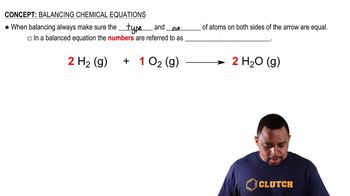
Balancing Chemical Equations

Balancing chemical equations involves ensuring that the number of atoms for each element is the same on both sides of the equation. This is based on the law of conservation of mass, which states that matter cannot be created or destroyed in a chemical reaction. To balance an equation, coefficients are adjusted in front of the chemical formulas to achieve equal atom counts.
Video consigliato:
Percorso guidato
01:32
Balancing Chemical Equations

Types of Chemical Reactions

Understanding the types of chemical reactions, such as synthesis, decomposition, single replacement, and double replacement, is crucial for predicting products and balancing equations. In the given reaction, the interaction between urea (CO(NH2)2) and hypochlorous acid (HOCl) suggests a redox process, where oxidation states change, leading to the formation of nitrogen trichloride (NCl3), carbon dioxide (CO2), and water (H2O).
Video consigliato:
Percorso guidato
02:25
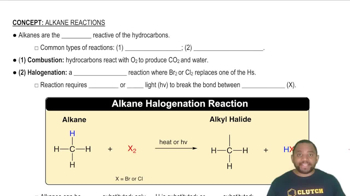
Common Types of Alkane Reactions

State Symbols in Chemical Reactions

State symbols indicate the physical state of the reactants and products in a chemical equation: (s) for solid, (l) for liquid, (g) for gas, and (aq) for aqueous solutions. These symbols provide important information about the conditions of the reaction and can influence the balancing process. In the given equation, recognizing the states helps in understanding the reaction environment and the nature of the products formed.
Video consigliato:
Percorso guidato
03:17
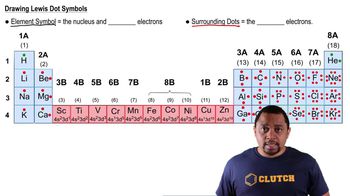
Lewis Dot Symbols