Ch.9 - Thermochemistry: Chemical Energy
McMurry - Chemistry 8th Edition
McMurry8th EditionChemistryISBN: 9781292336145Non è quello che usi tu?Cambia libro di testo
Capitolo 9, Problema 81

Calculate the amount of heat required to raise the tempera- ture of 250.0 g (approximately 1 cup) of hot chocolate from 25.0 °C to 80.0 °C. Assume hot chocolate has the same spe-cific heat as water 34.18 J>1g °C24.

Guida verificata passo dopo passo
1
Step 1: Identify the given values. The mass (m) of the hot chocolate is 250.0 g, the initial temperature (T1) is 25.0 °C, the final temperature (T2) is 80.0 °C, and the specific heat (c) is 4.18 J/g°C.
Step 2: Understand the formula to calculate heat (q), which is q = mcΔT, where ΔT is the change in temperature.
Step 3: Calculate the change in temperature (ΔT) by subtracting the initial temperature from the final temperature. ΔT = T2 - T1.
Step 4: Substitute the given values into the formula. q = (250.0 g) * (4.18 J/g°C) * (ΔT °C).
Step 5: Solve the equation to find the amount of heat required. Remember, the unit of the final answer should be in Joules (J).

Risposta video verificata per un problema simile:

Questa soluzione video è stata consigliata dai nostri tutor come utile per risolvere questo problema.
Durata del video:
2m

Concetti chiave

Ecco i concetti essenziali che devi comprendere per rispondere correttamente alla domanda.

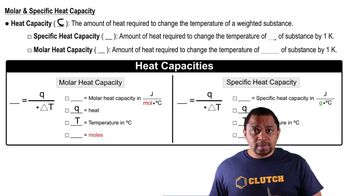
Specific Heat Capacity

Specific heat capacity is the amount of heat required to raise the temperature of one gram of a substance by one degree Celsius. It is a crucial property in thermodynamics, as it determines how much energy is needed to change the temperature of a material. For water, the specific heat capacity is approximately 4.18 J/g°C, which is used in this problem to calculate the heat required for the hot chocolate.
Video consigliato:

Heat Transfer

Heat transfer refers to the movement of thermal energy from one object or substance to another due to a temperature difference. In this context, heat is transferred to the hot chocolate to increase its temperature from 25.0 °C to 80.0 °C. The amount of heat transferred can be calculated using the formula Q = mcΔT, where Q is the heat added, m is the mass, c is the specific heat capacity, and ΔT is the change in temperature.
Video consigliato:

Temperature Change

Temperature change is the difference between the initial and final temperatures of a substance. In this problem, the temperature change (ΔT) is calculated by subtracting the initial temperature (25.0 °C) from the final temperature (80.0 °C). Understanding how to calculate this change is essential for determining the total heat required to raise the temperature of the hot chocolate.
Video consigliato:
Percorso guidato
02:03
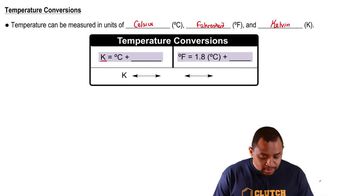
Temperature Conversion Formulas
Pratica correlata
Domanda del libro di testo
Titanium metal is used as a structural material in many high-tech applications, such as in jet engines. what is the specific heat of titanium in J/(g·°C) if it takes 89.7 J to raise the temeprature of a 33.0 g block of 5.20 °C? What is the molar heat capacity of titanium J/(mol·°C)?
1018
views
Domanda del libro di testo
Assuming that Coca-Cola has the saem specific heat as water [4.18 J/(g C)], calculate the amount of heat in kilojoules transferred when one can (about 350 g) is cooled from 25 C to 3 C.
1345
views
Domanda del libro di testo
Instant hot packs contain a solid and a pouch of water. When the pack is squeezed, the pouch breaks and the solid dis- solves, increasing the temperature because of the exothermic reaciton. The following reaction is used to make a hot pack: H2O LiCl1s2 ¡ Li 1aq2 + Cl 1aq2 ∆H = -36.9 kJ. What is the final temperature in a squeezed hot pack that contains 25.0 g of LiCl dissolved# in 125 mL of water? Assume a specific heat of 4.18 J>1g °C2 for the solution, an initial temperature of 25.0 °C, and no heat transfer between the hot pack and the environment.
1212
views
Domanda del libro di testo
Instant cold packs used to treat athletic injuries contain solid NH4NO3 and a pouch of water. When the pack is squeezed, the pouch breaks and the solid dissolves, lowering the tem-perature because of the endothermic reaction NH4NO31s2 ¡ NH4NO31aq2 ∆H = +25.7 kJ What is the final temperature in a squeezed cold pack that contains 50.0 g of NH4NO3 dissolved in 125 mL of water? Assume a specific heat of 4.18 J/(g C) for the solution, an initial temperature of 25.0 °C, and no heat transfer between the cold pack and the environment.
1652
views
Domanda del libro di testo
Sodium metal is sometimes used as a cooling agent in heat-exchange units because of its releatively high molar heat capacity fo 28.2 J/(mol·°C). What is the specific heat and molar heat capacity of sodium in J/g·°C?
1007
views
Domanda del libro di testo
When 0.187 g of benzene, C6H6, is burned in a bomb calorimeter the temperature rises by 3.45 °C. If the heat capacity of the calorimeter is 2.46 kJ>°C, calculate the combustion energy 1∆E2 for benzene in units of kJ/g and kJ/mol.
1148
views