Ch.9 - Thermochemistry: Chemical Energy
McMurry - Chemistry 8th Edition
McMurry8th EditionChemistryISBN: 9781292336145Non è quello che usi tu?Cambia libro di testo
Capitolo 9, Problema 113

Given the standard heats of formation shown in Appendix B, what is ΔH° in kilojoules for the reaciton 3 N2O4(g) + 2 H2O(l) → 4 HNO3(aq) + 2 NO(g)

Guida verificata passo dopo passo
1
Identify the standard heats of formation (ΔH_f°) for each compound involved in the reaction from Appendix B.
Write the balanced chemical equation: 3 N_2O_4(g) + 2 H_2O(l) → 4 HNO_3(aq) + 2 NO(g).
Use the formula for the standard enthalpy change of the reaction: ΔH° = Σ(ΔH_f° of products) - Σ(ΔH_f° of reactants).
Calculate the sum of the standard heats of formation for the products: 4(ΔH_f° of HNO_3) + 2(ΔH_f° of NO).
Calculate the sum of the standard heats of formation for the reactants: 3(ΔH_f° of N_2O_4) + 2(ΔH_f° of H_2O).

Risposta video verificata per un problema simile:

Questa soluzione video è stata consigliata dai nostri tutor come utile per risolvere questo problema.
Durata del video:
4m

Concetti chiave

Ecco i concetti essenziali che devi comprendere per rispondere correttamente alla domanda.

Standard Heat of Formation (ΔH°f)

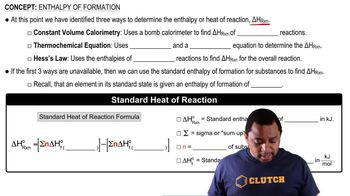
The standard heat of formation (ΔH°f) is the change in enthalpy when one mole of a compound is formed from its elements in their standard states. It is a crucial value used in thermodynamics to calculate the overall heat change in a chemical reaction. Each substance has a specific ΔH°f value, which can be found in tables, and these values are essential for determining the enthalpy change of reactions.
Video consigliato:
Percorso guidato
02:34
Enthalpy of Formation

Hess's Law

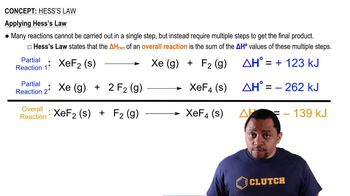
Hess's Law states that the total enthalpy change for a reaction is the sum of the enthalpy changes for the individual steps of the reaction, regardless of the pathway taken. This principle allows chemists to calculate the enthalpy change of a reaction by using known ΔH°f values of reactants and products, making it easier to analyze complex reactions that may occur in multiple steps.
Video consigliato:

Enthalpy Change (ΔH)

Enthalpy change (ΔH) is a measure of the heat absorbed or released during a chemical reaction at constant pressure. It indicates whether a reaction is exothermic (releases heat, ΔH < 0) or endothermic (absorbs heat, ΔH > 0). Understanding ΔH is essential for predicting the energy changes associated with chemical reactions, which is vital for both theoretical and practical applications in chemistry.
Video consigliato:
Percorso guidato
02:34
Enthalpy of Formation