

Ch.5 - Gases
Tro - Chemistry: A Molecular Approach 4th Edition
Tro4th EditionChemistry: A Molecular ApproachISBN: 9780134112831Non è quello che usi tu?Cambia libro di testo
Capitolo 5, Problema 43

An automobile tire has a maximum rating of 38.0 psi (gauge pressure). The tire is inflated (while cold) to a volume of 11.8 L and a gauge pressure of 36.0 psi at a temperature of 12.0 °C. On a hot day, the tire warms to 65.0 °C, and its volume expands to 12.2 L. Does the pressure in the tire exceed its maximum rating? (Note: The gauge pressure is the difference between the total pressure and atmospheric pressure. In this case, assume that atmospheric pressure is 14.7 psi.)

Guida verificata passo dopo passo
1
Identify the initial and final conditions of the gas in the tire: initial volume (V1) = 11.8 L, initial gauge pressure (P1) = 36.0 psi, initial temperature (T1) = 12.0 °C, final volume (V2) = 12.2 L, final temperature (T2) = 65.0 °C.
Convert the temperatures from Celsius to Kelvin by adding 273.15 to each temperature: T1 = 12.0 + 273.15 K, T2 = 65.0 + 273.15 K.
Calculate the initial absolute pressure (P1_abs) by adding atmospheric pressure to the initial gauge pressure: P1_abs = 36.0 psi + 14.7 psi.
Use the combined gas law \( \frac{P1 \times V1}{T1} = \frac{P2 \times V2}{T2} \) to solve for the final absolute pressure (P2_abs). Rearrange the equation to find P2_abs: \( P2_abs = \frac{P1 \times V1 \times T2}{T1 \times V2} \).
Subtract atmospheric pressure from the final absolute pressure to find the final gauge pressure (P2_gauge): P2_gauge = P2_abs - 14.7 psi. Compare P2_gauge to the maximum rating of 38.0 psi to determine if it exceeds the maximum rating.

Risposta video verificata per un problema simile:

Questa soluzione video è stata consigliata dai nostri tutor come utile per risolvere questo problema.
Durata del video:
6m

Concetti chiave

Ecco i concetti essenziali che devi comprendere per rispondere correttamente alla domanda.

Gauge Pressure vs. Absolute Pressure

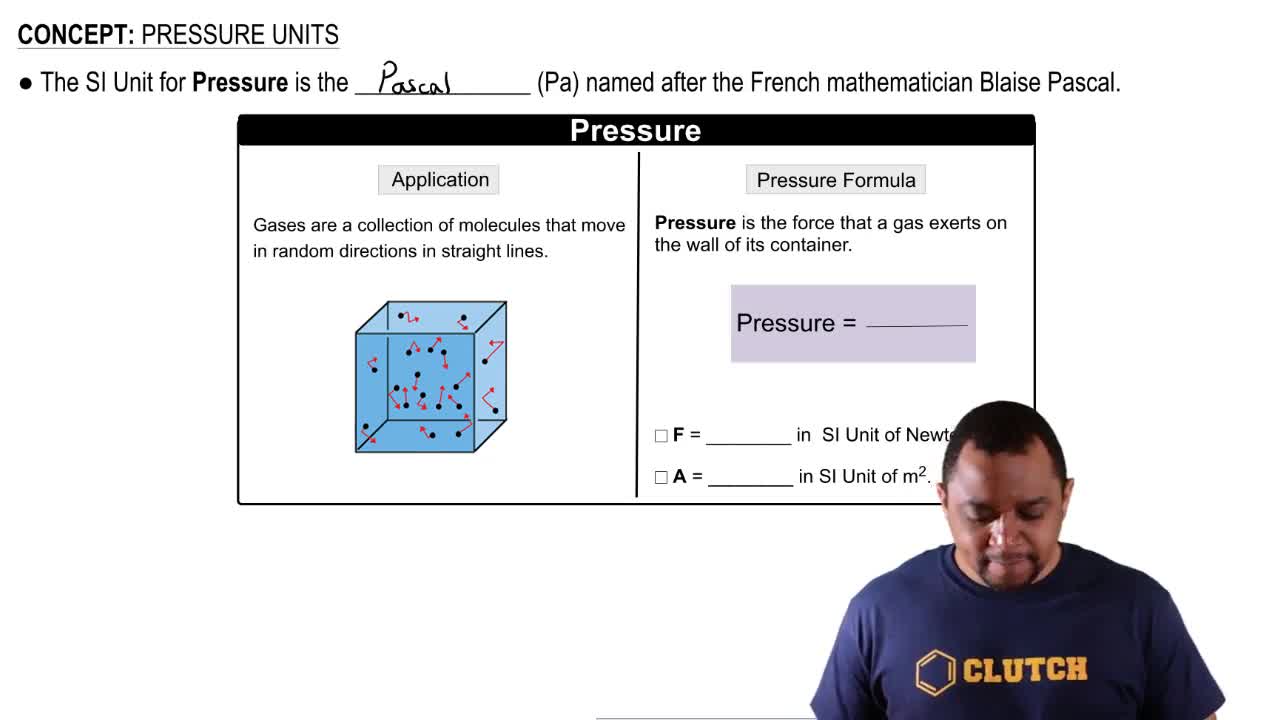
Gauge pressure measures the pressure relative to atmospheric pressure, meaning it does not include the atmospheric pressure in its value. To find the absolute pressure, which is crucial for calculations, you must add atmospheric pressure (14.7 psi) to the gauge pressure. For example, a gauge pressure of 36.0 psi corresponds to an absolute pressure of 50.7 psi (36.0 + 14.7).
Video consigliato:

Ideal Gas Law

The Ideal Gas Law (PV = nRT) relates the pressure (P), volume (V), temperature (T), and amount of gas (n) in a system. This law allows us to predict how changes in temperature and volume affect pressure. In this scenario, as the tire heats up and expands, we can use the Ideal Gas Law to determine the new pressure based on the initial conditions and the changes in temperature and volume.
Video consigliato:
Percorso guidato
01:15
Ideal Gas Law Formula

Charles's Law

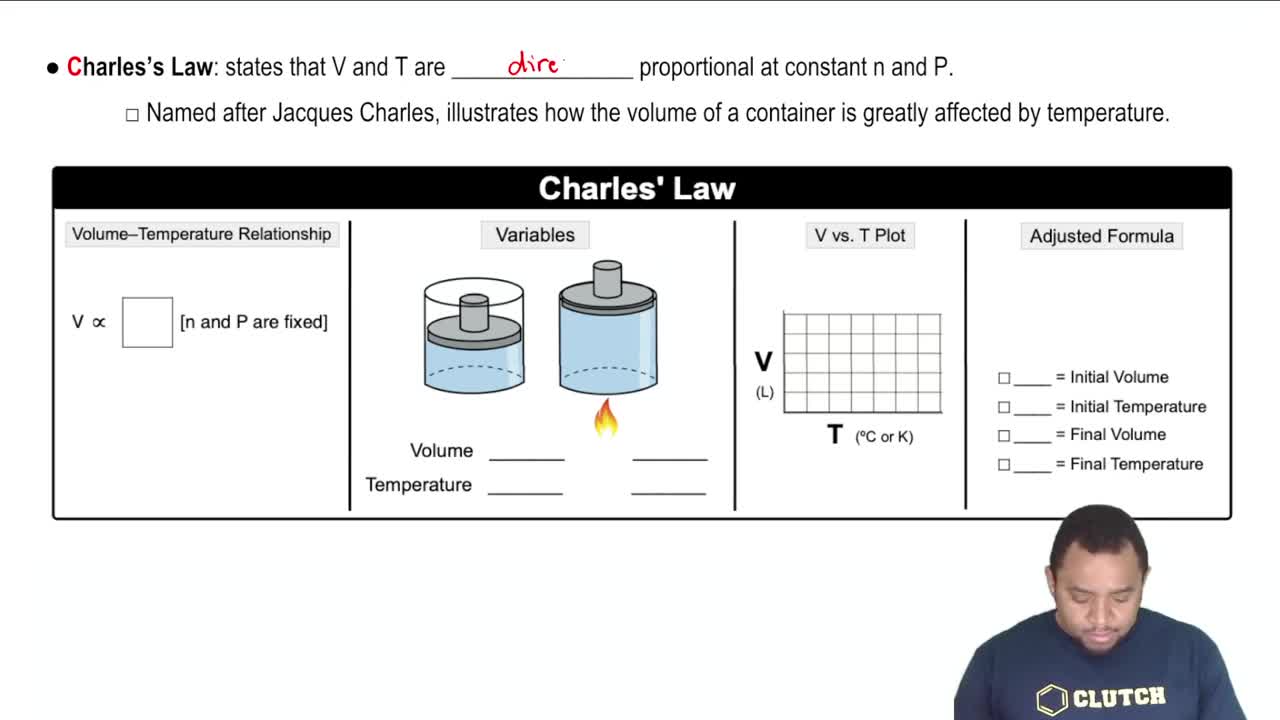
Charles's Law states that the volume of a gas is directly proportional to its temperature (in Kelvin) when pressure is held constant. This principle helps us understand how the volume of the tire changes with temperature. In this case, as the tire warms from 12.0 °C to 65.0 °C, the increase in temperature will lead to an increase in volume, which must be accounted for when calculating the final pressure.
Video consigliato: