

Ch.8 - Periodic Properties of the Elements
Tro - Chemistry: A Molecular Approach 4th Edition
Tro4th EditionChemistry: A Molecular ApproachISBN: 9780134112831Non è quello che usi tu?Cambia libro di testo
Capitolo 8, Problema 112

The first ionization energy of sodium is 496 kJ/mol. Use Coulomb's law to estimate the average distance between the sodium nucleus and the 3s electron. How does this distance compare to the atomic radius of sodium? Explain the difference.

Guida verificata passo dopo passo
1
Identify the given information: The first ionization energy of sodium is 496 kJ/mol.
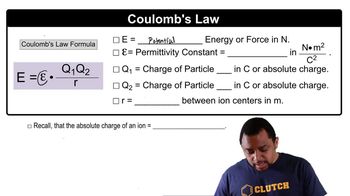
Recall Coulomb's law: \( F = \frac{k \cdot |q_1 \cdot q_2|}{r^2} \), where \( F \) is the force between two charges, \( k \) is Coulomb's constant, \( q_1 \) and \( q_2 \) are the charges, and \( r \) is the distance between the charges.
Convert the ionization energy from kJ/mol to J/atom by dividing by Avogadro's number.
Use the relationship between energy and force: \( E = F \cdot r \), where \( E \) is the ionization energy, to solve for \( r \). Rearrange to find \( r = \frac{k \cdot |q_1 \cdot q_2|}{E} \).
Compare the calculated distance \( r \) to the known atomic radius of sodium, and discuss why the ionization energy distance might differ from the atomic radius, considering factors like electron shielding and effective nuclear charge.

Risposta video verificata per un problema simile:

Questa soluzione video è stata consigliata dai nostri tutor come utile per risolvere questo problema.

Concetti chiave

Ecco i concetti essenziali che devi comprendere per rispondere correttamente alla domanda.

Ionization Energy

Ionization energy is the energy required to remove an electron from an atom in its gaseous state. For sodium, the first ionization energy of 496 kJ/mol indicates the energy needed to remove the outermost 3s electron. This concept is crucial for understanding the strength of the attraction between the nucleus and the electrons, which directly influences the distance between them.
Video consigliato:
Percorso guidato
01:19
Ionization Energy

Coulomb's Law

Coulomb's law describes the electrostatic interaction between charged particles, stating that the force between two charges is directly proportional to the product of their charges and inversely proportional to the square of the distance between them. In this context, it helps estimate the average distance between the sodium nucleus and its 3s electron by relating the ionization energy to the attractive force acting on the electron.
Video consigliato:
Percorso guidato
01:15
Coulomb's Law Concept 2

Atomic Radius

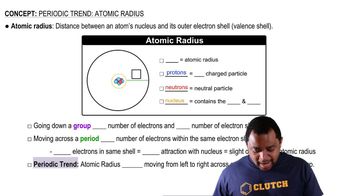
The atomic radius is a measure of the size of an atom, typically defined as the distance from the nucleus to the outermost electron shell. For sodium, the atomic radius provides a context for comparing the calculated distance from the nucleus to the 3s electron. Differences between this distance and the atomic radius can arise due to electron shielding and the distribution of electron density in the atom.
Video consigliato: