Use the Born–Haber cycle and data from Appendix IIB, Chapter 8 and this chapter to calculate the lattice energy of KCl. (ΔHsub for potassium is 89.0 kJ/mol.)
Ch.9 - Chemical Bonding I: The Lewis Model
Tro4th EditionChemistry: A Molecular ApproachISBN: 9780134112831Non è quello che usi tu?Cambia libro di testo
Capitolo 9, Problema 45
The lattice energy of CsF is -744 kJ/mol, whereas that of BaO is -3029 kJ/mol. Explain this large difference in lattice energy.
Guida verificata passo dopo passo1
Lattice energy is the energy required to separate one mole of an ionic solid into its gaseous ions. It is influenced by the charges of the ions and the distance between them.
CsF consists of Cs^+ and F^- ions, while BaO consists of Ba^2+ and O^2- ions. The charges on the ions in BaO are higher than those in CsF.
According to Coulomb's Law, the lattice energy is directly proportional to the product of the charges of the ions. Therefore, the higher charges in BaO result in a greater lattice energy.
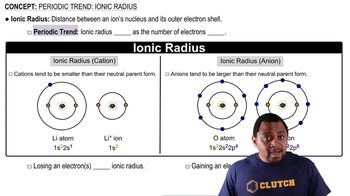
The size of the ions also affects lattice energy. Smaller ions can get closer together, increasing the lattice energy. Ba^2+ and O^2- are smaller than Cs^+ and F^-, contributing to the higher lattice energy of BaO.
In summary, the large difference in lattice energy between CsF and BaO is due to the higher ionic charges and smaller ionic radii in BaO, leading to stronger electrostatic attractions.

Risposta video verificata per un problema simile:
Questa soluzione video è stata consigliata dai nostri tutor come utile per risolvere questo problema.
Durata del video:
3mConcetti chiave
Ecco i concetti essenziali che devi comprendere per rispondere correttamente alla domanda.
Lattice Energy
Lattice energy is the amount of energy released when gaseous ions combine to form an ionic solid. It is a measure of the strength of the forces between the ions in an ionic compound. Higher lattice energy indicates stronger ionic bonds, which typically results from greater charges on the ions and smaller ionic radii.
Video consigliato:
Percorso guidato
Lattice Energy
Ionic Charge
The charge of the ions significantly influences lattice energy. In the case of CsF, cesium (Cs) has a +1 charge and fluoride (F) has a -1 charge, resulting in a relatively lower lattice energy. In contrast, BaO consists of barium (Ba) with a +2 charge and oxide (O) with a -2 charge, leading to a stronger electrostatic attraction and thus a higher lattice energy.
Video consigliato:
Percorso guidato
Formal Charge
Ionic Radius
The size of the ions, or ionic radius, also affects lattice energy. Smaller ions can pack more closely together, increasing the electrostatic attraction between them. In BaO, the smaller size of the oxide ion compared to the fluoride ion in CsF contributes to the larger lattice energy, as the closer proximity of the ions enhances the overall stability of the ionic lattice.
Video consigliato:
Percorso guidato
Ionic Radius
Pratica correlata
Domanda del libro di testo
850
views
1
rank
2
comments
Domanda del libro di testo
Use Lewis symbols to determine the formula for the compound that forms between each pair of elements. a. Ca and N b. Mg and I c. Ca and S d. Cs and F
1733
views
Domanda del libro di testo
Use the Born–Haber cycle and data from Appendix IIB and Table 9.3 to calculate the lattice energy of CaO. (ΔHsub for calcium is 178 kJ/mol; IE1 and IE2 for calcium are 590 kJ/mol and 1145 kJ/mol, respectively; EA1 and EA2 for O are -141 kJ/mol and 744 kJ/mol, respectively.)
2606
views
2
comments
Domanda del libro di testo
Rubidium iodide has a lattice energy of -617 kJ/mol, while potassium bromide has a lattice energy of -671 kJ/mol. Why is the lattice energy of potassium bromide more exothermic than the lattice energy of rubidium iodide?
1490
views