Ch.21 - Radioactivity & Nuclear Chemistry
Tro - Chemistry: A Molecular Approach 5th Edition
Tro5th EditionChemistry: A Molecular ApproachISBN: 9780134874371Non è quello che usi tu?Cambia libro di testo
Capitolo 21, Problema 81

Bismuth-210 is a beta emitter with a half-life of 5.0 days. If a sample contains 1.2 g of Bi-210 (atomic mass = 209.984105 amu), how many beta emissions occur in 13.5 days? If a person’s body intercepts 5.5% of those emissions, what amount of radiation (in Ci) is the person exposed to?

Guida verificata passo dopo passo
1
Calculate the number of half-lives that have passed in 13.5 days by dividing the total time by the half-life of Bi-210.
Use the number of half-lives to determine the remaining mass of Bi-210 using the formula: \( \text{Remaining mass} = \text{Initial mass} \times \left( \frac{1}{2} \right)^{\text{number of half-lives}} \).
Calculate the decayed mass of Bi-210 by subtracting the remaining mass from the initial mass.
Convert the decayed mass of Bi-210 to moles using its atomic mass (209.984105 amu).
Calculate the total number of beta emissions by multiplying the moles of decayed Bi-210 by Avogadro's number (\(6.022 \times 10^{23}\) atoms/mol) and then by the percentage of emissions intercepted (5.5%).

Concetti chiave

Ecco i concetti essenziali che devi comprendere per rispondere correttamente alla domanda.

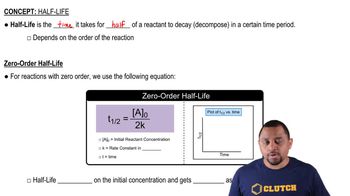
Half-life

Half-life is the time required for half of the radioactive nuclei in a sample to decay. For Bismuth-210, with a half-life of 5.0 days, this means that after 5 days, half of the original amount will have decayed. Understanding half-life is crucial for calculating the remaining quantity of a radioactive substance over time and predicting the number of decay events that will occur.
Video consigliato:
02:17
Zero-Order Half-life

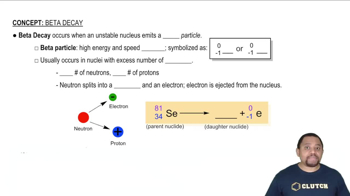
Beta decay

Beta decay is a type of radioactive decay in which a beta particle (an electron or positron) is emitted from an atomic nucleus. In the case of Bismuth-210, it undergoes beta decay, transforming into a different element while releasing energy. This process is essential for determining the number of emissions that occur over a specified time period, as each decay event corresponds to one beta emission.
Video consigliato:
03:01
Beta Decay

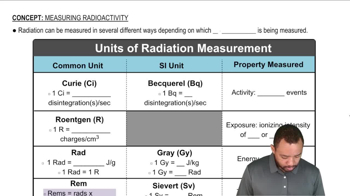
Radioactivity and exposure measurement

Radioactivity refers to the process by which unstable atomic nuclei lose energy by emitting radiation. The exposure to radiation can be quantified in curies (Ci), a unit that measures the activity of a radioactive source. To calculate the exposure a person receives from beta emissions, one must consider the total emissions and the percentage intercepted, allowing for an assessment of potential health risks associated with radiation exposure.
Video consigliato:
02:52
Units of Radiation Measurement