A sample of gas has an initial volume of 14.1 L at a pressure of 1.05 atm. If the sample is compressed to a volume of 10.1 L (at constant temperature), what is its pressure?

Ch.6 - Gases

Tro6th EditionChemistry: A Molecular ApproachISBN: 9780137832217Non è quello che usi tu?Cambia libro di testo
Capitolo 6, Problema 33
A sample of gas has an initial volume of 4.20 L at a pressure of 755 mmHg. If the volume of the gas is increased to 7.10 L (at constant temperature), what is its pressure?
Guida verificata passo dopo passo1
Identify the initial conditions: initial volume \( V_1 = 4.20 \text{ L} \) and initial pressure \( P_1 = 755 \text{ mmHg} \).
Identify the final condition: final volume \( V_2 = 7.10 \text{ L} \).
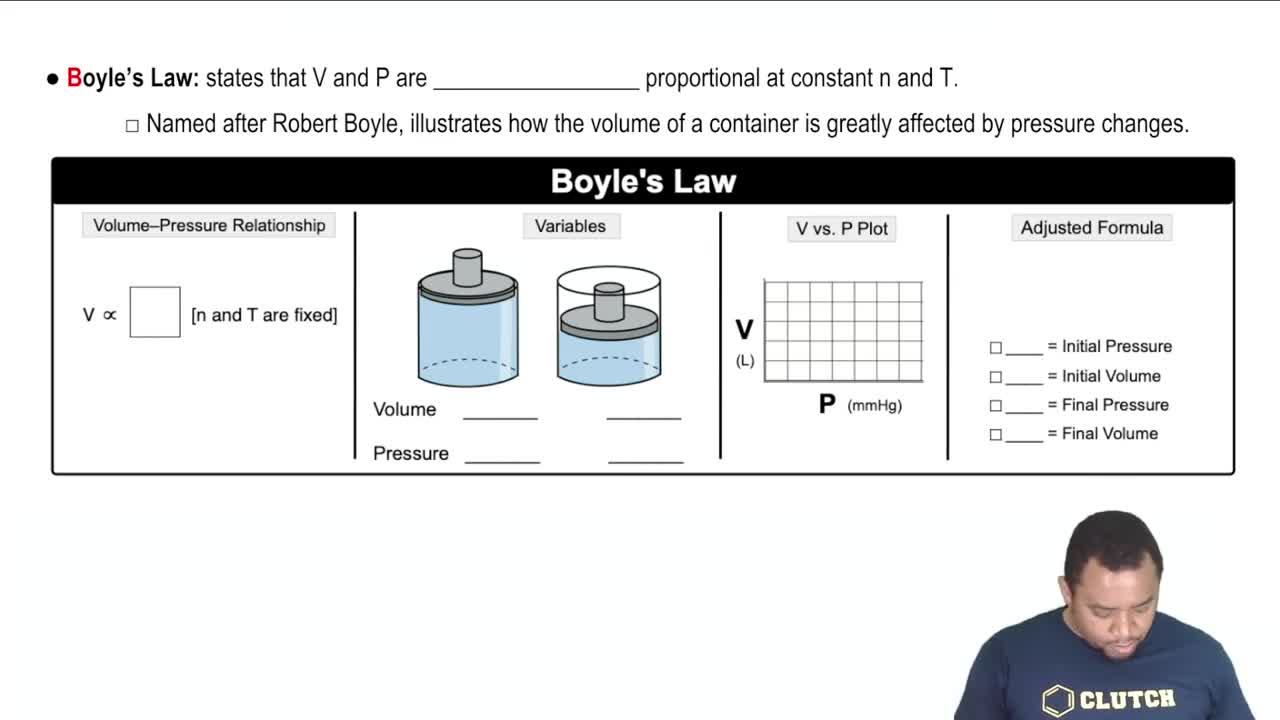
Recognize that the temperature is constant, so Boyle's Law applies: \( P_1 V_1 = P_2 V_2 \).
Rearrange Boyle's Law to solve for the final pressure \( P_2 \): \( P_2 = \frac{P_1 V_1}{V_2} \).
Substitute the known values into the equation to find \( P_2 \).

Risposta video verificata per un problema simile:
Questa soluzione video è stata consigliata dai nostri tutor come utile per risolvere questo problema.
Durata del video:
1mConcetti chiave
Ecco i concetti essenziali che devi comprendere per rispondere correttamente alla domanda.
Boyle's Law
Boyle's Law states that the pressure of a gas is inversely proportional to its volume when the temperature is held constant. This means that if the volume of a gas increases, its pressure decreases, and vice versa. Mathematically, it can be expressed as P1V1 = P2V2, where P and V represent pressure and volume, respectively, and the subscripts denote initial and final states.
Video consigliato:
Percorso guidato
Boyle's Law
Gas Laws
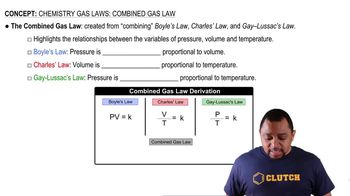
Gas laws describe the behavior of gases in relation to pressure, volume, and temperature. They include several key principles, such as Boyle's Law, Charles's Law, and Avogadro's Law, which together help predict how gases will respond to changes in their environment. Understanding these laws is essential for solving problems involving gas behavior.
Video consigliato:
Percorso guidato
Combined Gas Law
Units of Pressure
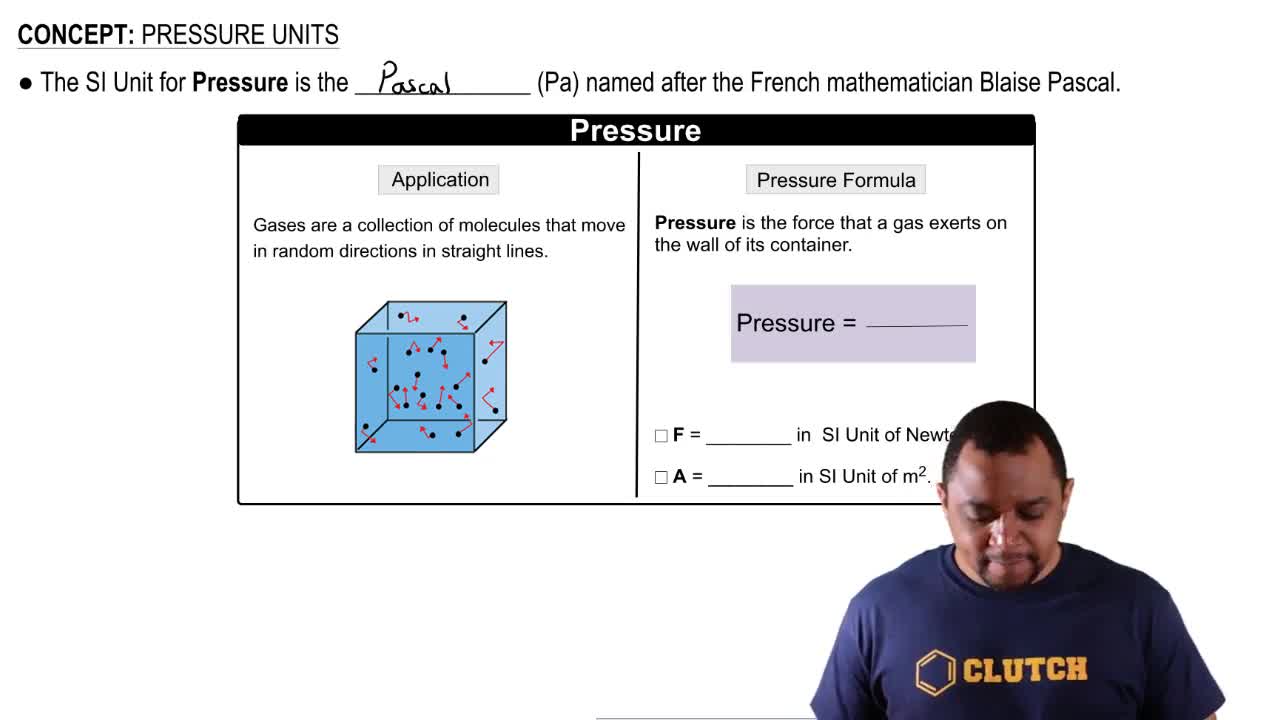
Pressure is a measure of force applied per unit area and can be expressed in various units, including atmospheres (atm), pascals (Pa), and millimeters of mercury (mmHg). In this context, it is important to ensure that pressure units are consistent when applying gas laws. Converting between units may be necessary to solve problems accurately.
Video consigliato:
Percorso guidato
Pressure Units
Pratica correlata
Domanda del libro di testo
A syringe containing 1.55 mL of oxygen gas is cooled from 95.3 °C to 0.0 °C. What is the final volume of oxygen gas?
2837
views
1
rank
Domanda del libro di testo
Given a barometric pressure of 751.5 mmHg, calculate the pressure of each gas sample as indicated by the manometer.
(a)
3686
views
1
comments
Domanda del libro di testo
Given a barometric pressure of 751.5 mmHg, calculate the pressure of each gas sample as indicated by the manometer.
(b)
487
views
Domanda del libro di testo
A 48.3-mL sample of gas in a cylinder is warmed from 22 °C to 87 °C. What is its volume at the final temperature?
2726
views
1
rank
1
comments
Domanda del libro di testo
The world record for lowest pressure (at sea level) was 652.5 mmHg recorded inside Typhoon Tip on October 12, 1979, in the western Pacific Ocean. Convert this pressure to each indicated unit. d. psi
584
views