Use Coulomb's law to calculate the ionization energy in kJ/mol of an atom composed of a proton and an electron separated by 110.00 pm. What wavelength of light has sufficient energy to ionize the atom?
Ch.9 - Periodic Properties of the Elements

Tro6th EditionChemistry: A Molecular ApproachISBN: 9780137832217Non è quello che usi tu?Cambia libro di testo
Capitolo 9, Problema 112
The first ionization energy of lithium is 520 kJ/mol. Use Coulomb's law to estimate the average distance between the lithium nucleus and the 2s electron. How does this distance compare to the atomic radius of lithium? Assume an effective nuclear charge of 1+ for the valence electron.
Guida verificata passo dopo passo1
Identify the given values: the first ionization energy (IE) of lithium is 520 kJ/mol, and the effective nuclear charge (Z_eff) is +1.
Convert the ionization energy from kJ/mol to joules per atom. Use the conversion factor: 1 kJ/mol = 1,000 J/mol and Avogadro's number (6.022 x 10^23 atoms/mol).
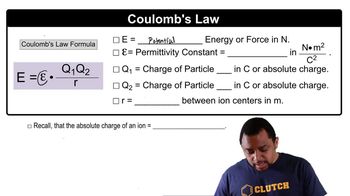
Apply Coulomb's law to relate the ionization energy to the distance (r) between the nucleus and the electron. Coulomb's law is given by: E = k * (Z_eff * e^2) / r, where E is the ionization energy, k is Coulomb's constant (8.99 x 10^9 N m^2/C^2), and e is the elementary charge (1.602 x 10^-19 C).
Rearrange the formula to solve for the distance r: r = k * (Z_eff * e^2) / E.
Compare the calculated distance r to the known atomic radius of lithium, which is approximately 152 pm (picometers).

Risposta video verificata per un problema simile:
Questa soluzione video è stata consigliata dai nostri tutor come utile per risolvere questo problema.
Concetti chiave
Ecco i concetti essenziali che devi comprendere per rispondere correttamente alla domanda.
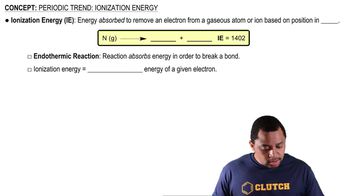
Ionization Energy
Ionization energy is the energy required to remove an electron from an atom in its gaseous state. For lithium, the first ionization energy is 520 kJ/mol, indicating the energy needed to remove the outermost electron. This concept is crucial for understanding the strength of the attraction between the nucleus and the electrons, which influences the distance between them.
Video consigliato:
Percorso guidato
Ionization Energy
Coulomb's Law
Coulomb's law describes the electrostatic interaction between charged particles. It states that the force between two charges is directly proportional to the product of their charges and inversely proportional to the square of the distance between them. This law can be used to estimate the distance between the lithium nucleus and its valence electron by relating the ionization energy to the attractive force experienced by the electron.
Video consigliato:
Percorso guidato
Coulomb's Law Concept 2
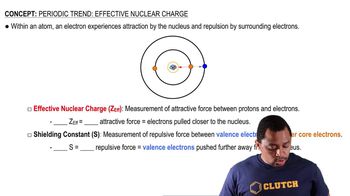
Effective Nuclear Charge
Effective nuclear charge (Z_eff) is the net positive charge experienced by an electron in a multi-electron atom, accounting for shielding by other electrons. For lithium, an effective nuclear charge of 1+ means that the valence electron feels a reduced attraction due to the presence of the inner electron. This concept is essential for calculating the distance between the nucleus and the electron, as it influences the strength of the electrostatic force in Coulomb's law.
Video consigliato:
Percorso guidato
Effective Nuclear Charge
Pratica correlata
Domanda del libro di testo
2
views
Domanda del libro di testo
You have cracked a secret code that uses elemental symbols to spell words. The code uses numbers to designate the elemental symbols. Each number is the sum of the atomic number and the highest principal quantum number of the highest occupied orbital of the element whose symbol is to be used. The message may be written forward or backward. Decode the following messages: a. 10, 12, 58, 11, 7, 44, 63, 66
2960
views
Domanda del libro di testo
Consider the elements: Na, Mg, Al, Si, P. b. Which element has the smallest atomic radius?
1578
views
Domanda del libro di testo
Consider the elements: Na, Mg, Al, Si, P. c. Which element is least metallic?
539
views
Domanda del libro di testo
Consider the elements: B, C, N, O, F. d. Which element has three unpaired electrons?
350
views