Mutation is an alteration in DNA sequence, including base-pair changes, insertions, deletions, or major chromosomal structure changes. It can occur in somatic or germ cells and in coding or noncoding regions.
What are point mutations and their types?
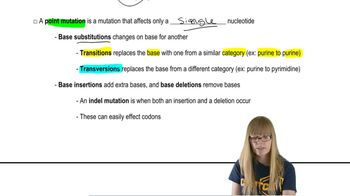
Point mutations are base substitutions. Types include missense (different amino acid), nonsense (stop codon), and silent (same amino acid).
Define transitions and transversions in base substitutions.
Transitions are substitutions of a purine for purine or pyrimidine for pyrimidine. Transversions are substitutions between purine and pyrimidine.
What causes frameshift mutations?
Frameshift mutations result from insertions or deletions of nucleotides that shift the triplet reading frame during translation.
What is a loss-of-function mutation?
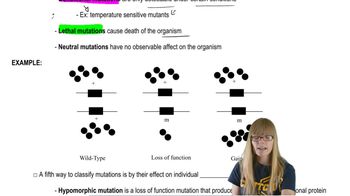
A mutation that reduces or eliminates the function of the gene product. A null mutation causes complete loss of function.
Explain haploinsufficiency.
Occurs when one allele is inactivated by mutation, leaving only one functional copy that may not produce enough gene product for a wild-type phenotype.
What is a gain-of-function mutation?
A mutation that codes for a gene product with enhanced, negative, or new function.
Differentiate somatic and germ-line mutations.
Somatic mutations occur in non-gamete cells and are not heritable. Germ-line mutations occur in gametes and are inherited.
What are spontaneous mutations?
Mutations that occur naturally from normal biological or chemical processes altering nitrogenous bases, with very low rates.
What are induced mutations?
Mutations caused by external factors like radiation, UV light, and chemicals.
What is replication slippage?
During DNA replication, loops in the template strand cause DNA polymerase to miss nucleotides, leading to small insertions or deletions.
What are tautomeric shifts?
Temporary changes in base structure that allow noncomplementary base pairing, increasing mutation risk.
Describe depurination and deamination.
Depurination is loss of purine bases creating apurinic sites. Deamination converts amino groups in bases, e.g., cytosine to uracil, causing base-pair changes.
What are transposable elements?
DNA elements that move within or between genomes, causing mutations like inversions and translocations.
What are base analogs and their effect?
Chemicals that substitute for purines or pyrimidines during DNA synthesis, increasing mutation rates and UV sensitivity.
How do alkylating agents cause mutations?
They donate alkyl groups to nucleotide bases, altering base-pairing and causing transition mutations.
What is the effect of UV light on DNA?
UV light induces pyrimidine dimers, distorting DNA and causing replication errors.
What is the Ames test used for?
A test using Salmonella strains to detect mutagenicity of compounds by measuring reverse mutation frequency.
What is DNA mismatch repair?
A repair system that detects and removes mismatched bases after replication using strand discrimination based on methylation.
Describe photoreactivation repair.
An enzyme-mediated repair that cleaves thymine dimers using light energy; absent in humans.
What is nucleotide excision repair?
A repair mechanism that removes bulky DNA lesions by excising damaged nucleotides and filling the gap.
What causes xeroderma pigmentosum?
A genetic disorder caused by defects in nucleotide excision repair, leading to high skin cancer risk.
What are the two pathways for double-strand break repair?
Homologous recombination repair (uses sister chromatid) and nonhomologous end joining (direct ligation of ends).
What are retrotransposons?
Transposable elements that move via an RNA intermediate and can amplify within the genome.
What percentage of the human genome is composed of transposable elements?
Approximately 34%, including LINEs (long interspersed elements) and SINEs (short interspersed elements).
 Indietro

 03:49