 Indietro
DNA Replication and Genetic Linkage in Genetics
 14:31

Termini in questo insieme (20)
To make an exact copy of the DNA quickly, accurately, and at the appropriate time in the cell cycle.
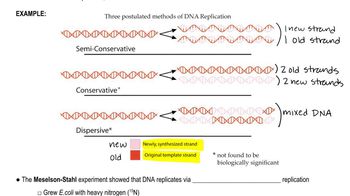
(a) Conservative, (b) Semiconservative, (c) Dispersive.
The semiconservative model, where each daughter DNA molecule contains one parental and one new strand.
DNA polymerase catalyzes the formation of phosphodiester bonds between nucleotides, synthesizing DNA in the 5’ to 3’ direction and requires a primer with a free 3’-OH.
It provides a proofreading function to remove mismatched nucleotides, increasing replication fidelity.
It is the single starting point where replication begins and proceeds bidirectionally.
Leading strand is synthesized continuously in the 5’ to 3’ direction; lagging strand is synthesized discontinuously as Okazaki fragments.
DNA polymerase I removes RNA primers using 5’ to 3’ exonuclease activity and replaces them with DNA.
DNA ligase seals the nicks between Okazaki fragments to form a continuous DNA strand.
Because eukaryotic chromosomes are large and linear, multiple origins allow DNA to be replicated in a reasonable time.
DNA polymerase cannot fully replicate the 3’ ends of linear chromosomes, leading to progressive shortening of chromosomes.
Telomeres are special repetitive DNA sequences at chromosome ends that protect them from degradation and prevent loss of important DNA.
Telomerase extends the 3’ overhang of telomeres using an RNA template to add repeats, allowing complete replication of chromosome ends.
Genes located close together on the same chromosome tend to be inherited together and do not assort independently.
Crossing over during meiosis exchanges chromosome segments, producing new allele combinations.
Greater distance between genes increases the likelihood of crossing over and recombination frequency.
A genetic map shows gene order and relative distances; map distance represents the frequency of recombination between genes, expressed in map units or centimorgans.
Maximum is 50%, which occurs when genes assort independently or are far apart, making them behave like genes on different chromosomes.
Rare crossing over during mitosis can produce recombinant chromosomes, potentially causing patches of tissue with different genetic traits.
Through induced fit in the active site and 3’ to 5’ exonuclease proofreading activity that removes mismatched bases.