Skip to main content
Genetics
Il mio corso
Impara
Preparazione agli esami
AI Tutor
Guide di studio
Soluzioni per libri di testo
Flashcard
Esplora
Prova l'app
Il mio corso
Impara
Preparazione agli esami
AI Tutor
Guide di studio
Soluzioni per libri di testo
Flashcard
Esplora
Prova l'app
Indietro
Genetic Material: Structure and Organization
Puoi toccare per girare la carta.
What are the four essential properties a molecule must have to serve as genetic material?
Puoi toccare per girare la carta.
👆
What are the four essential properties a molecule must have to serve as genetic material?
Replication
,
information storage
,
information expression
, and
allowing variation by mutation
.
Avanzamenti del tracciato
I pulsanti di controllo sono stati cambiati in modalità "navigazione".
1/21
Video consigliati
09:32
History and Experiments
3553
views
68
rank
1
comments
Termini in questo insieme (21)
Nascondere definizioni
What are the four essential properties a molecule must have to serve as genetic material?
Replication
,
information storage
,
information expression
, and
allowing variation by mutation
.
Who first extracted DNA and what was it originally called?
F. Meischer in 1869 extracted a phosphorus-rich, acidic material called
nuclein
from nuclei, later identified as DNA.
What was the significance of the Feulgen reaction in DNA research?
It showed that DNA localized almost exclusively within chromosomes by staining cells red.
Why was protein initially thought to be the genetic material instead of DNA?
Proteins have 20 amino acids allowing greater diversity, while DNA was considered too simple with only 4 nucleotides.
What did Griffith's 1928 experiment demonstrate?
That a 'transforming principle' from heat-killed virulent S strain bacteria could convert nonvirulent R strain into virulent form.
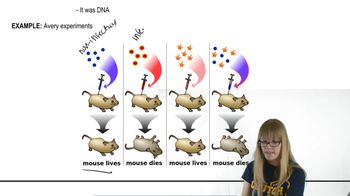
What did Avery, MacLeod, and McCarty prove in 1944?
They identified DNA as the 'transforming principle' responsible for genetic transformation in bacteria.
What was the key finding of the Hershey-Chase experiment?
DNA, not protein, is the genetic material injected by bacteriophages into bacteria to direct viral replication.
What are nucleotides composed of?
A nitrogenous base, a pentose sugar, and a phosphate group.
What type of bond links nucleotides in DNA and RNA?
Phosphodiester bonds between the phosphate group at the 5' carbon and the hydroxyl group at the 3' carbon.
State Chargaff's rules regarding DNA base composition.
In DNA, the amount of adenine (A) approximately equals thymine (T), and guanine (G) approximately equals cytosine (C).
Describe the Watson and Crick model of DNA structure.
A right-handed double helix with two antiparallel polynucleotide strands connected by complementary base pairing (A-T, C-G).
What is the length of one complete turn of the DNA helix and how many base pairs does it contain?
One turn is 34 Å (3.4 nm) long and contains 10 base pairs.
Name the alternative DNA conformations besides B-DNA.
A-DNA (more compact), C-DNA, D-DNA, E-DNA, P-DNA (less compact right-handed), and Z-DNA (left-handed helix).
What is chromatin and how is DNA organized within it?
Chromatin is DNA wrapped around histone proteins forming nucleosomes, which further fold into higher-order structures.
What are histones and their role in DNA packaging?
Positively charged proteins (H1, H2A, H2B, H3, H4) that bind DNA to form nucleosomes and compact chromatin.
Differentiate euchromatin and heterochromatin.
Euchromatin contains active genes and is less condensed; heterochromatin is gene-poor or repressed and more condensed.
What defines homologous chromosomes?
Pairs of chromosomes in diploid organisms that have the same gene loci but may carry different alleles.
What is the function of the centromere on a chromosome?
It is the constricted region that serves as the attachment site for spindle fibers during chromosome segregation.
What is a karyotype?
A visual representation of the number, size, and shape of homologous chromosome pairs in a cell.
What are polytene chromosomes and where are they found?
Large chromosomes with paired homologs and visible puffs indicating gene activity, found in tissues like salivary glands.
What are lampbrush chromosomes?
Large chromosomes with extensive DNA looping found in vertebrate oocytes and some insect spermatocytes, showing active transcription sites.
 IndietroIndietro
 09:32
