Skip to main content
Genetics
Il mio corso
Impara
Preparazione agli esami
AI Tutor
Guide di studio
Soluzioni per libri di testo
Flashcard
Esplora
Prova l'app
Il mio corso
Impara
Preparazione agli esami
AI Tutor
Guide di studio
Soluzioni per libri di testo
Flashcard
Esplora
Prova l'app
Indietro
Genetics: DNA and RNA Structure and Genetic Material
Puoi toccare per girare la carta.
What are the four key properties of genetic material?
Puoi toccare per girare la carta.
👆
What are the four key properties of genetic material?
Information
to make an organism,
transmission
from parent to offspring,
replication
to be copied, and
variation
to allow change.
Avanzamenti del tracciato
I pulsanti di controllo sono stati cambiati in modalità "navigazione".
1/20
Video consigliati
09:32
History and Experiments
3553
views
68
rank
1
comments
Termini in questo insieme (20)
Nascondere definizioni
What are the four key properties of genetic material?
Information
to make an organism,
transmission
from parent to offspring,
replication
to be copied, and
variation
to allow change.
What was Griffith's experiment with Streptococcus pneumoniae demonstrating?
Living type R bacteria transformed into virulent type S when mixed with heat-killed type S, indicating a 'transforming principle' in genetic material.
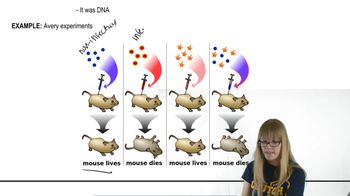
What macromolecule did Avery, MacLeod, and McCarty identify as the genetic material?
DNA
was identified as the transforming principle responsible for heredity, not proteins, lipids, or carbohydrates.
What was the key conclusion of the Hershey-Chase experiment?
DNA, not protein, is the genetic material injected by bacteriophages into bacteria to direct viral replication.
Why is UV light at 260 nm most mutagenic to genetic material?
DNA and RNA absorb UV light strongly at 260 nm, causing mutations, whereas proteins absorb at 280 nm with less mutagenic effect.
What is Chargaff's rule regarding DNA base composition?
In DNA, the amount of adenine equals thymine (A=T) and guanine equals cytosine (G=C).
What is the structure of a nucleotide in DNA and RNA?
A nucleotide consists of a phosphate group, a sugar (deoxyribose in DNA, ribose in RNA), and a nitrogenous base.
What are the two types of nitrogenous bases in nucleic acids?
Purines
(adenine and guanine) with double rings, and
pyrimidines
(cytosine, thymine in DNA, uracil in RNA) with single rings.
How are nucleotides linked in a DNA strand?
By
phosphodiester bonds
connecting the 5′ carbon of one sugar to the 3′ carbon of the next, giving strand directionality from 5′ to 3′.
What did Rosalind Franklin's X-ray diffraction data reveal about DNA?
DNA has a helical structure, is too wide for a single strand, and has about 10 base pairs per turn.
Describe the Watson and Crick model of DNA structure.
DNA is a right-handed double helix with two antiparallel strands held by hydrogen bonds between complementary bases: A pairs with T, G pairs with C.
What is the orientation of the two DNA strands in the double helix?
The strands are
antiparallel
, running in opposite directions: one 5′ to 3′, the other 3′ to 5′.
How many nucleotides are there per turn in the DNA double helix?
There are approximately 10 nucleotides per complete 360° turn of the helix.
What is the difference between DNA and RNA nucleotides?
DNA contains deoxyribose sugar and thymine; RNA contains ribose sugar and uracil instead of thymine.
What is the typical structure of RNA molecules?
RNA is usually single-stranded but can form short double-stranded regions via complementary base pairing (A-U, C-G).
Name the three major classes of RNA and their functions.
rRNA
: structural ribosome component,
mRNA
: template for protein synthesis,
tRNA
: carries amino acids to ribosomes.
What is the function of the anticodon loop in tRNA?
It contains a triplet of bases that pairs with the complementary codon on mRNA during translation.
What is the significance of the 3′ end of tRNA?
The 3′ end is the acceptor site where an amino acid is attached for protein synthesis.
What is the central dogma of molecular biology?
Information flows from DNA to RNA to protein, describing the process of gene expression.
How do the bases pair in DNA and RNA?
In DNA, adenine pairs with thymine; in RNA, adenine pairs with uracil; guanine pairs with cytosine in both.
 IndietroIndietro
 09:32
